Omanghana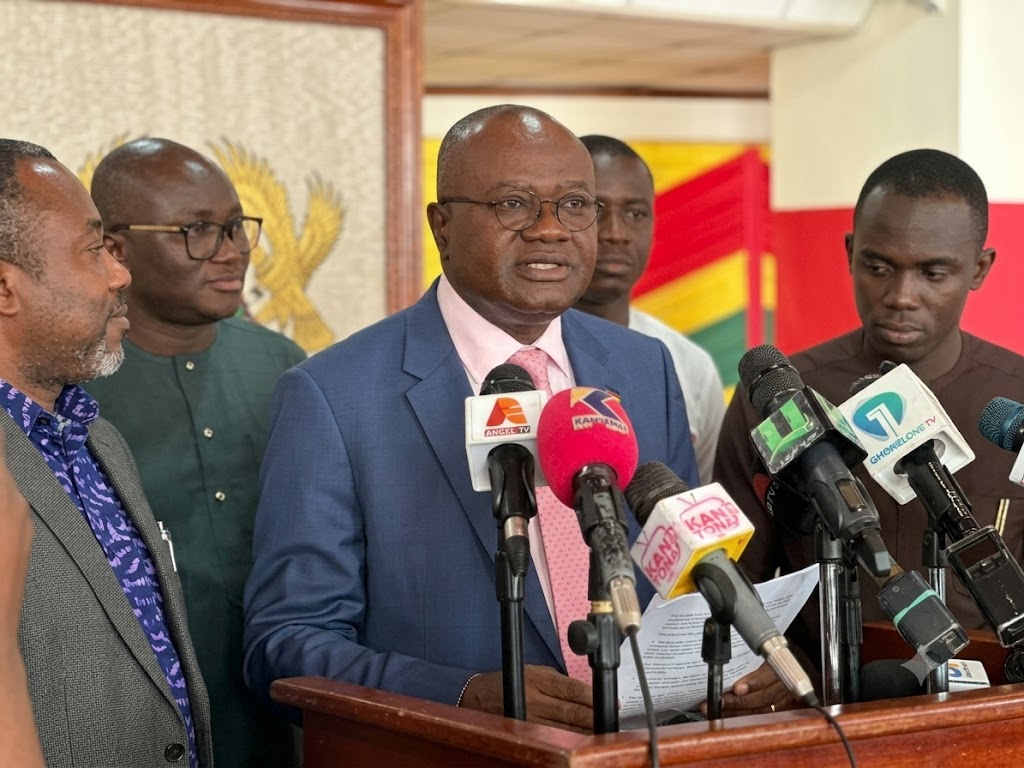
The Minority Caucus in Parliament has rejected the House’s ratification of six mining lease agreements, alleging that the documents contained serious legal, procedural and technical deficiencies.
Addressing the Parliamentary Press Corps on Friday, July 31, 2026, the Ranking Member on the Lands and Natural Resources Committee, Kwaku Ampratwum-Sarpong, accused the Minerals Commission of failing to conduct adequate due diligence before submitting the agreements for approval.
The leases involve Golden Star Wassa Limited, Maripoma Mining Services Limited, Perseus Mining Limited and Damang Gold Mine Limited, a special-purpose vehicle associated with Engineers and Planners Limited.
Two of the six leases relate to the Damang mining operation, which is being managed by Engineers and Planners, an indigenous company owned by businessman Ibrahim Mahama.
Ampratwum-Sarpong said the Minority supports responsible mining, foreign investment and greater participation by Ghanaian-owned businesses in the extractive sector. He insisted, however, that those objectives must not be pursued at the expense of constitutional safeguards and the national interest.
“This statement is not an attack on mining investment, neither is it an attempt to frustrate legitimate businesses operating within our mining sector,” he said.
“Ghana needs responsible investment, and the Minority remains committed to promoting a competitive, transparent and investor-friendly mining industry.”
According to the Ranking Member, the caucus identified several shortcomings during the committee’s examination of the agreements. These allegedly included unsigned cadastral plans, incomplete legal documents, missing mining operation programmes and the omission of the State’s statutory 10 per cent free-carried interest from some of the leases.
He described the alleged irregularities as serious governance failures that should have been addressed before the agreements were brought before Parliament.
“Our concern is simple: Parliament cannot compromise the national interest by approving defective mining leases involving Ghana’s mineral wealth without the level of scrutiny that the Constitution demands,” Ampratwum-Sarpong stated.
The Minority also alleged that, apart from Maripoma Mining Services Limited, some of the companies had already commenced or continued mining activities before their leases received parliamentary approval.
Ampratwum-Sarpong argued that such conduct undermined Article 268(1) of the 1992 Constitution, which requires parliamentary ratification of agreements involving the exploitation of Ghana’s natural resources.
He maintained that parliamentary approval must be obtained before companies begin extracting minerals and should not be treated as a formality after operations have commenced.
The Ranking Member also cited Article 257(6) of the Constitution, which provides that Ghana’s mineral resources are vested in the President on behalf of and in trust for the people.
He said that constitutional arrangement placed a responsibility on Parliament to scrutinise resource agreements carefully rather than automatically endorsing documents presented by the Executive.
“Parliament is not a ceremonial institution that merely endorses agreements placed before it by the Executive,” he said. “Parliament exists to ensure that the Executive manages the people’s resources lawfully, transparently and in the national interest.”
Ampratwum-Sarpong further alleged that concerns raised by Minority members during the committee’s deliberations were not adequately captured in the final report submitted to the House.
He claimed the signed committee report was given to him only minutes before proceedings began, leaving Minority members with insufficient time to review it and prepare a detailed response.
The caucus subsequently accused the Majority of treating Parliament as a “conveyor belt” for approving mining agreements, regardless of the quality of the supporting documents or unresolved constitutional questions.
It also warned mining companies operating in Ghana to comply fully with the Constitution, the Minerals and Mining Act and all other relevant regulations.
“The law of Ghana is not negotiable,” Ampratwum-Sarpong stated. “Every company seeking to exploit the mineral resources of this republic has a duty to comply fully with the Constitution.”
The Minority said it would continue documenting suspected breaches and demand accountability in the administration of Ghana’s mineral resources.
It also called for all identified deficiencies in the agreements to be corrected and for future mining leases to undergo more rigorous parliamentary scrutiny.
The Minerals Commission and the government had not publicly responded to the Minority’s specific allegations at the time of reporting.
Source: Omanghana