Omanghana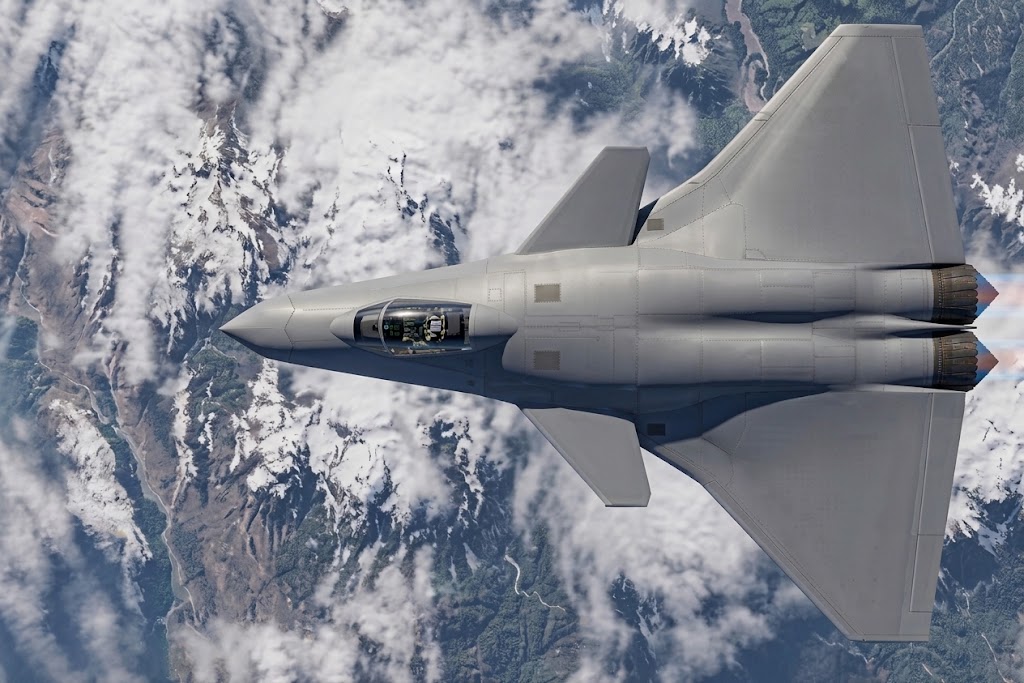
South Korea is expanding its aerospace and defense ambitions through two separate initiatives: early research into a domestically developed sixth-generation stealth fighter and negotiations to supply Egypt with FA-50 light combat aircraft under an initial agreement valued at approximately $1 billion.
Although both developments demonstrate South Korea’s growing position in the global military aviation industry, they involve different technologies, timelines and strategic objectives.
South Korea Studies Tailless Stealth Fighter
South Korean defense research agencies have begun conceptual and feasibility studies for an advanced fighter aircraft intended to succeed the KF-21 Boramae.
The proposed aircraft features a tailless design that eliminates conventional vertical and horizontal tail surfaces. This configuration could significantly reduce its radar cross-section, particularly when viewed from the sides and rear, improving its ability to evade detection across multiple radar frequencies.
Early concepts reportedly focus on a single-seat, twin-engine aircraft equipped with internal weapons bays to maintain a low-observable profile during combat missions.
Other capabilities being studied include supercruise, which would allow the aircraft to fly at supersonic speeds without continuously using fuel-intensive afterburners, and adaptive-cycle engines designed to improve both performance and fuel efficiency.
The proposed fighter could also feature a manned-unmanned teaming system, enabling the pilot to coordinate autonomous aircraft or drone swarms during surveillance, electronic warfare and combat operations.
South Korea’s sixth-generation fighter initiative remains a long-term research program rather than an approved production project. Any operational aircraft emerging from the studies would likely not enter service until the late 2030s or 2040s.
The research is intended to ensure that South Korea keeps pace with other next-generation fighter programs, including the United States’ Next Generation Air Dominance initiative and the multinational Global Combat Air Program being pursued by the United Kingdom, Italy and Japan.
Egypt Negotiates $1 Billion FA-50 Agreement
While advancing its long-term fighter research, Korea Aerospace Industries is also working to finalize a major export agreement with Egypt for the FA-50 Fighting Eagle.
The initial proposal reportedly covers 36 aircraft valued at approximately $1 billion. A broader framework could eventually increase the order to as many as 100 aircraft, making it one of Africa’s largest tactical aviation procurement programs.
The FA-50 is a supersonic light combat aircraft developed from KAI’s T-50 advanced jet trainer. It can be used for pilot training, air defense, ground-attack operations and other tactical missions.
A key component of the proposed agreement is local production. The arrangement could allow as many as 70 aircraft to be assembled or manufactured at the Arab Organization for Industrialization facility in Helwan.
Local assembly would support Egypt’s efforts to expand its domestic defense manufacturing capacity, create technical jobs and reduce its dependence on fully imported military equipment.
Egypt Could Become Regional FA-50 Hub
Under the proposed partnership, Egypt could also become a regional center for FA-50 maintenance, repair and overhaul services.
The country could potentially support aircraft operated by other customers across the Middle East and North Africa while serving as a base for future exports to regional markets.
Egypt is considering the FA-50 as part of efforts to replace its ageing fleet of Franco-German Alpha Jets and Chinese-built K-8E training aircraft.
The Korean aircraft’s reported level of parts and systems compatibility with Egypt’s Lockheed Martin F-16 fleet could provide additional operational benefits. Common equipment and similar systems could reduce training requirements, simplify maintenance and improve logistical efficiency.
Two Separate Aerospace Programs
Despite their simultaneous development, the proposed Egyptian agreement and South Korea’s sixth-generation fighter research are not connected.
Negotiations with Egypt concern the FA-50, a mature light combat aircraft based on existing fourth-generation technology. The tailless stealth fighter, meanwhile, remains a domestic research concept intended to explore technologies for South Korea’s future air-combat requirements.
There is no indication that the next-generation stealth project forms part of the FA-50 negotiations or is being considered for technology transfer to Egypt.
Source: Omanghana