Omanghana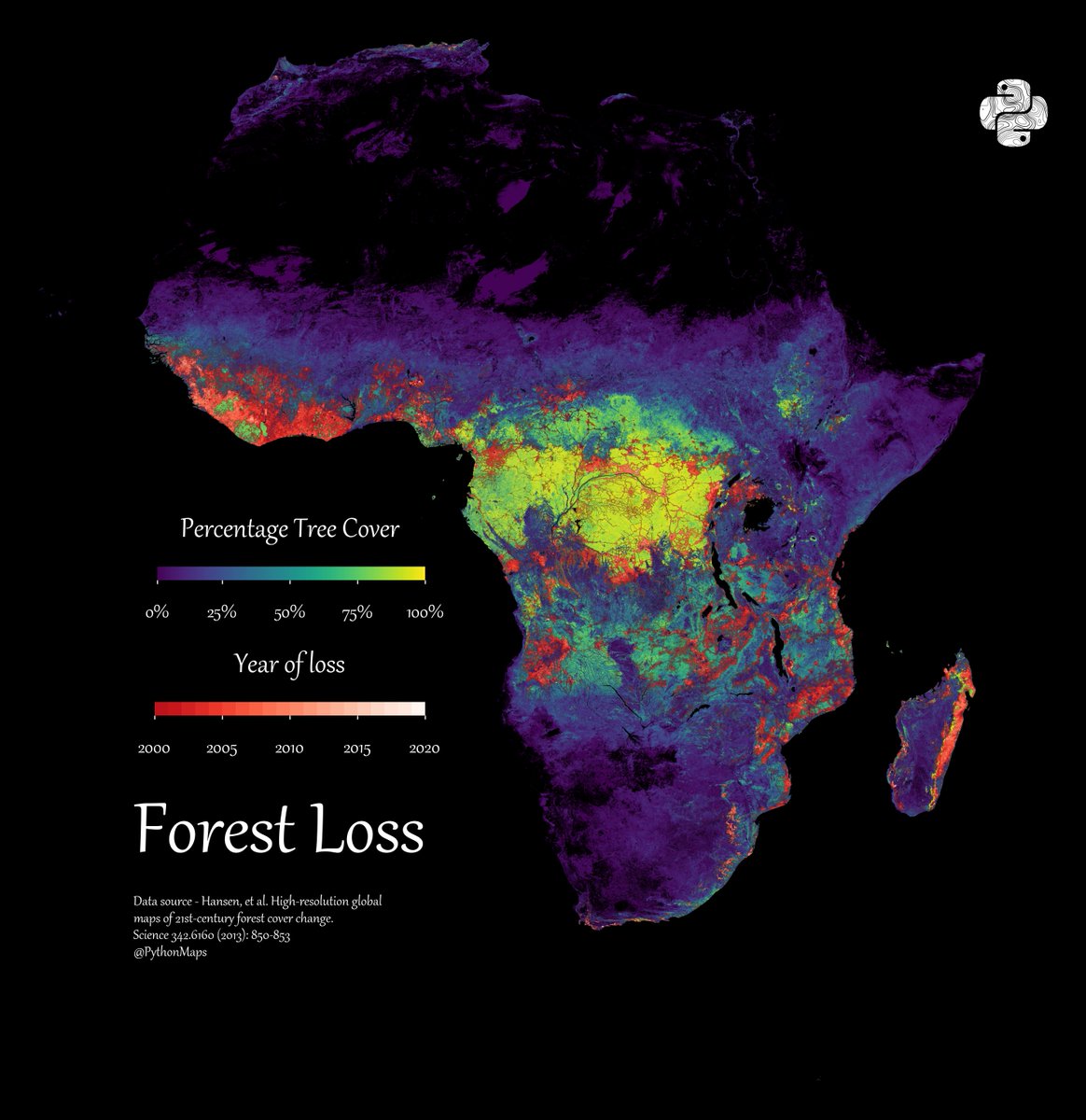
Africa continues to experience the highest rate of net forest loss globally, with agricultural expansion, shifting cultivation, and commercial commodity production emerging as the primary forces behind the continent’s changing landscapes. Satellite-based monitoring data indicate that millions of hectares of tree cover have been altered over recent decades, raising concerns about biodiversity, climate resilience, and sustainable land management.
Researchers commonly rely on forest monitoring systems such as those developed by Global Forest Watch and the University of Maryland to assess changes in tree cover. These datasets focus on what is known as “stand-replacement disturbance,” a measure that records areas where forest canopy transitions completely from a densely wooded state to an open, non-forest condition.
Unlike partial logging or selective harvesting, this metric captures locations where canopy cover effectively drops to zero, signaling a major transformation in land use or vegetation cover.
Understanding Stand-Replacement Forest Loss
Stand-replacement loss occurs when an entire section of forest is cleared or destroyed, leaving little to no remaining canopy. This can result from agricultural expansion, logging operations, severe wildfires, or other activities that remove most existing tree cover.
However, experts caution that this measure should not automatically be interpreted as permanent deforestation. In some cases, forests may regenerate naturally or through replanting efforts after temporary disturbances such as rotational timber harvesting or wildfire events.
Conversely, the metric does not account for forest degradation, where selective logging or incremental removal of trees weakens forest ecosystems without eliminating overall canopy cover.
Congo Basin Remains the Epicenter of Tropical Forest Loss
Central Africa’s Congo Basin—home to the world’s second-largest tropical rainforest after the Amazon—continues to account for a significant share of the continent’s forest loss.
The Democratic Republic of the Congo (DRC), in particular, has experienced extensive tree cover changes driven largely by small-scale subsistence farming practices. Many rural communities rely on slash-and-burn or shifting cultivation methods, clearing forested land for agriculture before moving to new areas as soil fertility declines.
Fuelwood collection also contributes to forest pressure, especially in regions where access to alternative energy sources and modern infrastructure remains limited.
Despite these challenges, the Congo Basin remains one of the planet’s most important carbon sinks and a critical habitat for thousands of plant and animal species.
West Africa’s Forests Under Pressure from Cocoa and Commercial Logging
In West Africa, decades of land conversion have significantly fragmented once-continuous forest ecosystems.
Countries such as Côte d’Ivoire, Ghana, and Nigeria have seen substantial reductions in their primary coastal forests, with agricultural expansion playing a leading role. Cocoa cultivation, in particular, has become one of the most influential drivers of forest conversion as global demand for chocolate continues to rise.
Commercial timber extraction has also contributed to habitat loss, reducing forest connectivity and threatening biodiversity in some of the region’s most ecologically valuable areas.
The combined effects of farming and logging have transformed landscapes that were once dominated by dense tropical forests into mosaics of plantations, farmland, and remaining forest fragments.
East and Southern Africa Face Distinct Environmental Challenges
Forest change in East and Southern Africa presents a different set of dynamics.
Madagascar continues to experience extensive habitat transformation, with its unique forests facing pressure from agricultural expansion and land-use change. Meanwhile, the dry miombo woodlands stretching across countries such as Mozambique and Uganda have recorded significant stand-replacement events.
Rapid population growth has increased demand for farmland and settlement areas, leading to widespread land clearing. In addition, seasonal wildfires frequently affect the region’s drier ecosystems, causing sudden and extensive canopy loss that is readily detected by satellite monitoring systems.
Distinguishing Temporary Loss from Permanent Deforestation
A crucial distinction in interpreting forest data is that tree cover loss does not always equate to irreversible deforestation.
Temporary disturbances—including managed timber harvests and areas affected by wildfire—may eventually recover through natural regeneration or reforestation efforts. As a result, annual tree cover loss figures should not automatically be interpreted as permanent conversion to non-forest land.
At the same time, some forms of ecological damage remain invisible in stand-replacement datasets. Selective logging, illegal extraction of valuable tree species, and gradual forest degradation can significantly reduce ecosystem health while leaving enough canopy intact to avoid classification as total forest loss.
Balancing Development and Conservation
Africa’s forests support millions of livelihoods while serving as vital reservoirs of biodiversity and carbon storage. As demand for agricultural land and natural resources continues to grow, policymakers face the challenge of balancing economic development with long-term environmental sustainability.
Strengthening sustainable farming practices, improving land-use planning, promoting responsible commodity supply chains, and investing in forest conservation initiatives will be essential to slowing forest loss and protecting the continent’s ecosystems for future generations.
Source: PythonMaps /Omanghana