Omanghana
China’s military engagement in Africa is shifting from small-scale training missions and anti-piracy operations towards increasingly sophisticated exercises designed to test long-range deployment, joint combat and overseas logistical capabilities.
The expanding drills suggest that Africa is becoming an important testing ground for the People’s Liberation Army as Beijing seeks to strengthen its ability to move and sustain military forces far beyond East Asia.
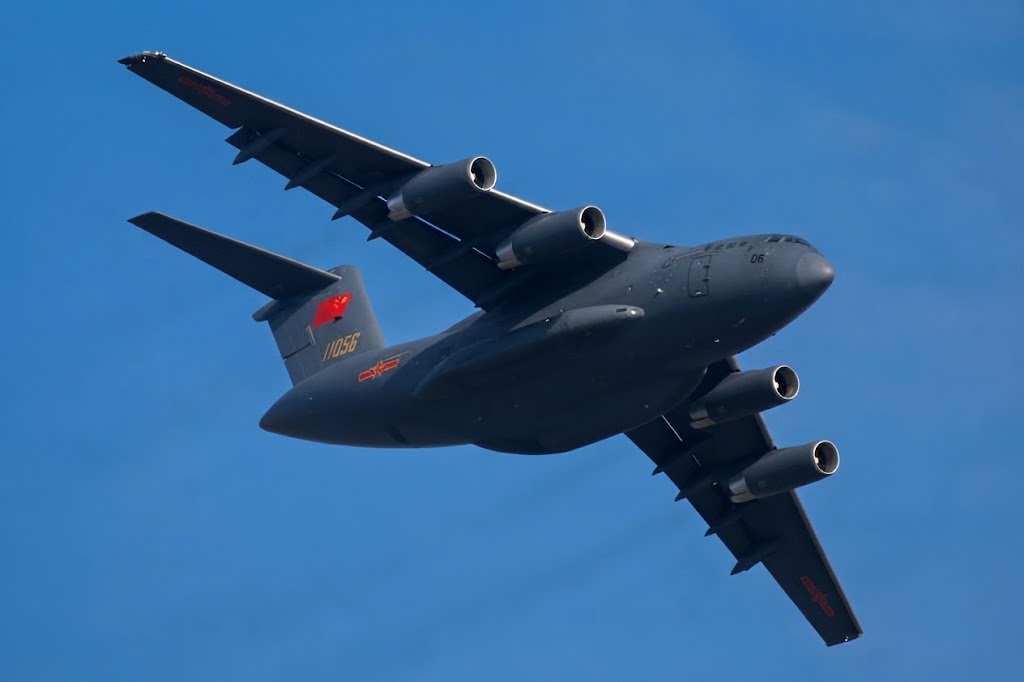
A major example is the China-Egypt “Eagles of Civilization” air exercise. The inaugural edition in 2025 involved Chinese J-10C fighters, KJ-500 airborne early-warning aircraft and YY-20 refueling tankers. The 2026 exercise represented a significant increase in scale and complexity, with China deploying J-16 multirole fighters, YY-20A tankers, Y-20A strategic transports, a KJ-500 surveillance aircraft and additional support platforms.
The Chinese contingent reportedly travelled more than 6,000 kilometers across two continents and four countries in approximately nine hours, supported by aerial refueling. The operation demonstrated the People’s Liberation Army Air Force’s growing capacity to deploy an integrated combat formation over intercontinental distances.
The exercise also included simulated engagements between China’s J-16 fighters and Egypt’s French-built Rafales. The drills gave Chinese pilots a rare opportunity to train against an advanced Western-designed fighter outside Asia and test different combat formations and command systems. No independently verified results from the simulated encounters were released.
China has simultaneously expanded its naval activity through multinational exercises. “Will for Peace 2026,” hosted in South African waters and led by China, brought together vessels from China, South Africa, Russia, Iran and the United Arab Emirates, while several other BRICS Plus countries participated as observers.
The exercise focused officially on protecting shipping routes, maritime safety, interoperability, counterterrorism rescue and maritime strike operations. China deployed the destroyer Tangshan and fleet oiler Taihu, which had been serving with a Chinese anti-piracy escort task force in the Gulf of Aden.
China’s wider expeditionary progression was also demonstrated during the 2024 “Peace Unity” exercise with Tanzania and Mozambique. That deployment included Y-20 strategic transport aircraft and Type 071 amphibious landing ships, known by NATO as the Yuzhao class, carrying personnel and equipment directly from mainland China.
Defense analysts say these exercises serve two purposes. They provide African militaries with training, technology exposure and alternative defense partnerships, while allowing China to practice aerial refueling, strategic lift, amphibious operations, overseas logistics and coordination between different military services.
For African governments, deeper cooperation with China may broaden procurement and training options. However, it also raises questions about strategic dependence, political alignment and the risk of becoming entangled in competition among major global powers.
Analysts have therefore urged African countries to retain greater control over the objectives and design of foreign-led exercises. They argue that military partnerships should address the continent’s security priorities while preserving nonalignment, legislative oversight and strategic autonomy.
Source: Omanghana