Omanghana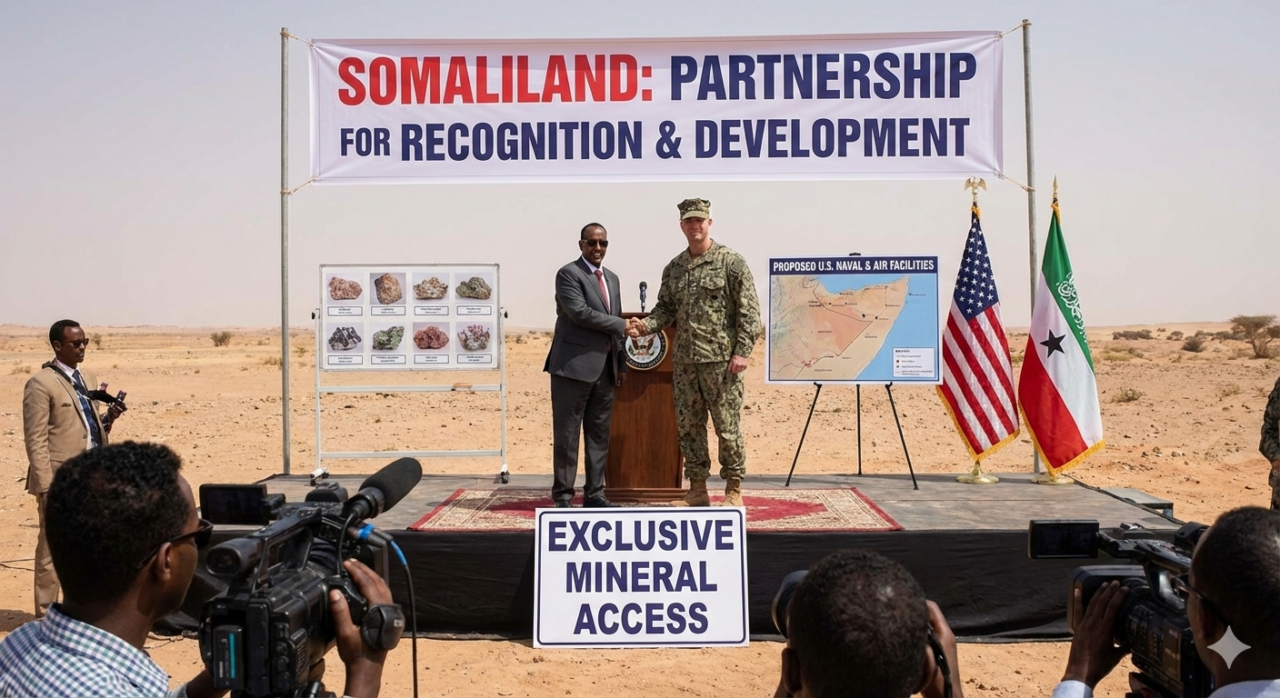
The self-declared Republic of Somaliland has announced it is prepared to offer the United States exclusive access to its mineral resources and host American military bases, in a bold diplomatic move aimed at securing formal international recognition.
The announcement was made by Somaliland’s Minister of the Presidency, Khadar Hussein Abdi, who described the offer as part of a strategic realignment toward Washington amid intensifying global competition for resources and security partnerships.
Strategic Minerals at the Center of the Proposal
At the heart of Somaliland’s offer is what officials describe as exclusive exploration and development rights to the territory’s mineral resources. According to the government, these deposits are believed to include lithium, coltan, and rare earth elements—materials considered critical to electric vehicle battery production, renewable energy systems, and advanced defense technologies.
Somaliland authorities argue that granting preferential access to U.S. firms would give Washington a secure and politically aligned source of minerals at a time when global supply chains are increasingly contested.
However, analysts caution that while Somaliland has long promoted its mineral potential, independent geological studies verifying the scale, quality, and commercial viability of these deposits remain limited, raising questions about timelines and returns.
Openness to Hosting U.S. Military Facilities
In addition to resource access, Somaliland has signaled its willingness to host American military facilities, potentially at the strategically located Berbera Port and Berbera Airport.
Berbera sits along the Gulf of Aden, near some of the world’s busiest shipping lanes and close to regional flashpoints involving piracy, militant groups, and geopolitical rivalries. A permanent U.S. presence there could enhance American power projection across the Horn of Africa, the Red Sea corridor, and the western Indian Ocean.
Aimed at the Trump Administration
Somaliland officials made clear that the proposal is explicitly directed at the Trump administration, expressing confidence that a transactional understanding could be reached. In exchange for security access and economic concessions, Somaliland hopes to obtain formal U.S. diplomatic recognition—a goal it has pursued unsuccessfully since declaring independence from Somalia in 1991.
Recognition by Washington would represent a diplomatic breakthrough for Somaliland and could potentially reshape its international standing.
Triggered by Israeli Recognition
The announcement follows a landmark development in December 2025, when Israel became the first United Nations member state to formally recognize Somaliland’s independence. That move was hailed by Somaliland authorities as validation of their long-standing claim to sovereignty and appears to have emboldened the government to pursue broader recognition.
Somalia Pushes Back with Its Own Offer
The federal government of Somalia, based in Mogadishu, has strongly rejected Somaliland’s initiative, describing it as unlawful and invalid under international law.
In response, Somalia has reportedly offered to renew a 1980 bilateral agreement with the United States, which would grant Washington legal access to Somali ports and airports for military purposes. Mogadishu argues that such arrangements must be negotiated exclusively with the internationally recognized Somali state.
Regional and International Opposition
The move has drawn sharp criticism from regional and international actors. African Union officials have reiterated their long-standing position in favor of Somalia’s territorial integrity.
Turkey, a major political and military partner of Somalia, has also voiced strong opposition. Turkish President Recep Tayyip Erdoğan recently warned that external recognition of Somaliland would undermine Somalia’s sovereignty and threaten regional stability in the Horn of Africa.
High Stakes, Uncertain Outcome
Somaliland’s proposal underscores how intensifying competition for strategic minerals, military positioning, and diplomatic influence is reshaping global alliances. While the offer could appeal to U.S. strategic interests, it also carries significant legal, diplomatic, and regional risks.
Whether Washington is willing to trade long-standing adherence to Somalia’s territorial integrity for security and resource access remains uncertain. What is clear, however, is that Somaliland has escalated its campaign for recognition—placing itself squarely at the center of a rapidly evolving geopolitical contest in the Horn of Africa.
Source: Omanghana