Omanghana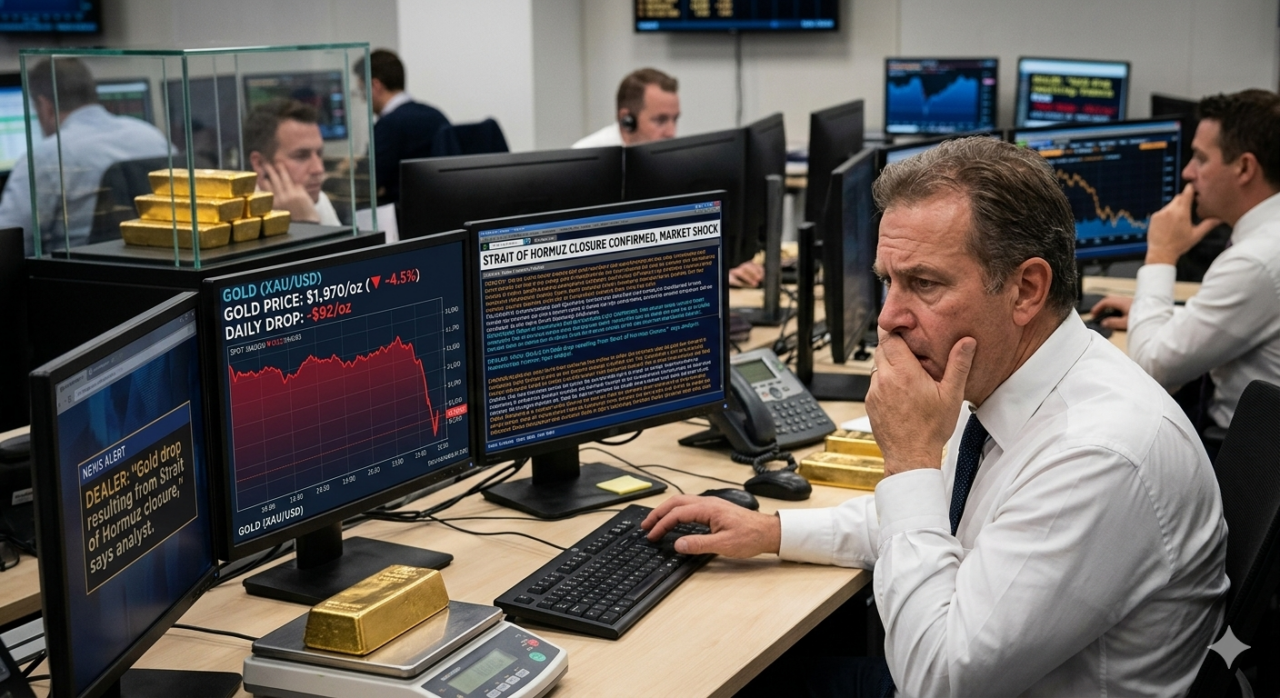
Global gold prices have fallen sharply from their January 2026 record highs as escalating geopolitical tensions and the prolonged closure of the Strait of Hormuz continue to reshape global financial markets.
Gold prices have declined by roughly 15% to 16% from their peak near $5,500 per ounce earlier this year, with the precious metal recently trading around $4,534 per ounce. The decline has surprised many investors, as gold traditionally benefits from geopolitical instability and war-driven uncertainty as a safe-haven asset.
However, analysts say the ongoing blockade of the Strait of Hormuz has created broader macroeconomic pressures that are now outweighing gold’s traditional defensive appeal.
According to market analysis from American Hartford Gold and independent commodity researchers, several overlapping economic forces are contributing to the sell-off.
One of the biggest drivers has been the surge in global oil prices following the disruption of energy shipments through the Gulf region. Crude oil prices have reportedly climbed above $109 per barrel as supply concerns intensify. Higher oil prices are feeding global inflation expectations, increasing pressure on central banks to maintain restrictive monetary policies.
Investors now expect the Federal Reserve System to keep interest rates elevated for longer or potentially implement additional rate hikes to contain inflation. Higher interest rates typically reduce the attractiveness of non-yielding assets such as gold because investors can earn stronger returns from interest-bearing instruments like government bonds.
Market analysts also point to heavy profit-taking after gold’s massive rally throughout 2025, during which prices surged by nearly 70% amid aggressive central bank purchases and global uncertainty. As geopolitical tensions intensified in 2026, many institutional investors reportedly moved to lock in gains, accelerating downward pressure on prices.
The liquidity strain caused by the Hormuz blockade has also affected major investment funds in Gulf economies. Analysts say several institutions tied to the Gulf Cooperation Council (GCC) were forced to liquidate portions of their gold holdings to raise cash as oil export revenues became constrained by the regional crisis.
At the same time, the conflict has strengthened the U.S. dollar, with the dollar index recording some of its strongest performances in months. A stronger dollar generally weakens demand for dollar-denominated commodities such as gold among international buyers, further contributing to the correction.
Despite the recent decline, major financial institutions including Goldman Sachs and ING Group remain optimistic about gold’s longer-term outlook. Analysts at both firms reportedly believe the precious metal could rebound toward the $5,000 to $5,400 range by the end of 2026 if slowing economic growth and persistent inflation eventually force central banks to ease monetary tightening.
Source: Omanghana