Omanghana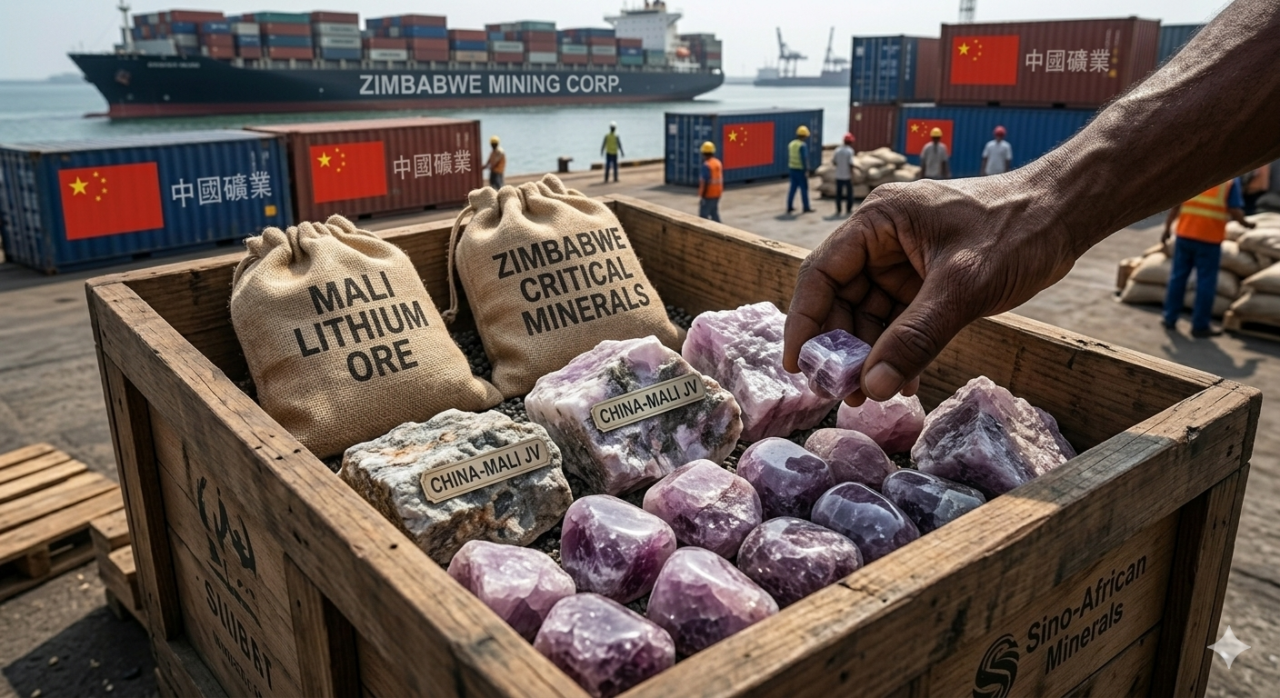
China is rapidly strengthening its dominance over Africa’s green energy supply chains through aggressive acquisitions of strategic lithium assets across Mali, Zimbabwe, and Ghana. Analysts say the latest wave of investments is accelerating Beijing’s control over the global electric vehicle battery market at a time when many Western mining firms are scaling back operations due to rising development costs, regulatory uncertainty, and growing resource nationalism across the continent.
Chinese battery and mining giants are increasingly pursuing integrated infrastructure-for-minerals deals that combine extraction rights with processing plants, transport networks, and long-term supply agreements. Industry observers warn that the strategy is leaving the United States and European Union increasingly dependent on China for refined battery metals essential to electric vehicle production and clean energy technologies.
One of the most significant developments is unfolding in Ghana’s Ewoyaa lithium project, where Zhejiang Huayou Cobalt has launched a $210 million cash takeover bid for Atlantic Lithium. By assuming the project’s remaining development costs, Huayou is positioning itself to secure control of up to 87% of the strategically important lithium asset. Analysts say the move could significantly weaken Western ambitions to channel Ghanaian lithium supplies into the American electric vehicle market.
In Zimbabwe, Chinese state-backed firms have expanded their influence by investing heavily in domestic lithium processing infrastructure. The strategy follows the earlier $422 million acquisition of the Arcadia Lithium Project by Chinese interests and comes after the Zimbabwean government imposed restrictions on raw lithium ore exports. By rapidly building local refining facilities, Chinese operators successfully adapted to the policy shift and ensured continued exports of processed lithium sulfate directly into China’s battery manufacturing ecosystem.
Meanwhile, Ganfeng Lithium has consolidated full ownership of Mali’s massive Goulamina lithium project after buying out its remaining Western partners through a specialized acquisition structure. The project is estimated to contain approximately 267 million tonnes of lithium resources and is increasingly viewed as a cornerstone of China’s emerging West African battery metals corridor.
The evolving ownership landscape highlights a growing strategic divide between Chinese and Western mining approaches in Africa. Western firms are increasingly described as risk-averse, often streamlining portfolios or abandoning projects during commodity price downturns. Chinese companies, by contrast, benefit from strong backing through state-linked financial institutions, enabling them to absorb market volatility and maintain long-term investments even during difficult economic conditions.
Another major difference lies in infrastructure integration. Western companies have traditionally focused on isolated mining investments with limited downstream development, while Chinese firms typically bundle acquisitions with roads, refineries, energy systems, and guaranteed mineral offtake agreements. This integrated approach has proven particularly effective in countries seeking to expand local processing capacity and reduce dependence on raw mineral exports.
Chinese companies have also shown greater willingness to finance expensive refining infrastructure within African countries, allowing them to comply with growing export restrictions designed to encourage domestic value addition. Analysts note that many Western firms have been reluctant to commit similar levels of capital to local processing operations due to cost concerns and uncertain returns.
The geopolitical implications of the shift are becoming increasingly significant for the global automotive and renewable energy sectors. China already controls an estimated 85% to 90% of global rare earth refining capacity. By securing upstream extraction assets across Africa while simultaneously dominating downstream refining and battery manufacturing, Beijing is constructing a vertically integrated supply chain capable of controlling nearly every stage of the electric vehicle production cycle.
Industry experts warn that the retreat of Western-linked miners from African lithium projects could deepen supply chain vulnerabilities for American and European automakers, especially as global demand for electric vehicle batteries continues to surge in the coming decade.
Source: Omanghana