Omanghana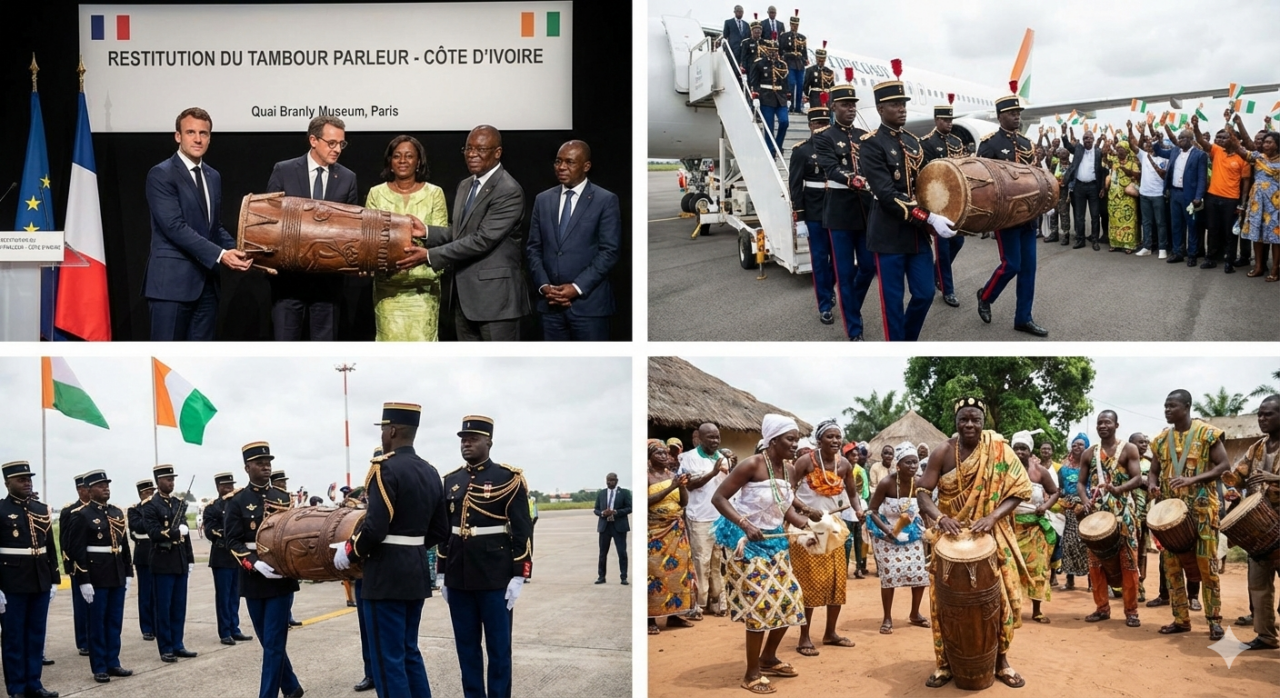
France has officially repatriated the Djidji Ayôkwé, a sacred ceremonial “talking drum,” to Ivory Coast, ending more than a century of exile and marking a major milestone in the global movement to return African cultural heritage.
The historic handover concludes 110 years during which the artifact remained in France after being seized during the colonial era. The return is widely regarded as both a cultural restoration and a powerful diplomatic gesture.
The Djidji Ayôkwé is an imposing wooden drum measuring approximately 3.5 meters (11.5 feet) in length and weighing between 430 and 530 kilograms. For generations, it served as a vital communication tool for the Ebrié (Atchan) people of southern Ivory Coast.
Using its deep, resonant tones, the drum transmitted warning messages across long distances, summoned villagers for ceremonies, and played a central role in community organization. During the colonial period, it also became a symbol of resistance, capable of mobilizing communities against external threats.
The drum was confiscated in 1916 by the French colonial army near Abidjan. According to historical accounts, the seizure was intended to suppress local resistance by silencing the drum’s powerful “voice,” which authorities viewed as a tool for coordination and defiance.
Following its removal, the artifact was transferred to France, where it remained in public collections for more than a century.
The formal repatriation ceremony took place in Paris, attended by senior officials from both countries. Ivory Coast was represented by Culture Minister Françoise Remarck, while France was represented by Culture Minister Rachida Dati.
Officials from both sides described the return as an act of historical justice and cultural reconciliation.
Once back in Ivory Coast, the Djidji Ayôkwé will be permanently displayed in a new national museum in Abidjan, currently under construction. The facility is intended to house cultural artifacts repatriated from abroad and to serve as a center for education, preservation, and national memory.
Ivorian authorities say the drum’s return will help reconnect younger generations with ancestral traditions and reaffirm the cultural identity of the Ebrié people.
The return required an exceptional legal process. Under French law, objects held in public collections are considered “inalienable,” meaning they cannot ordinarily be transferred or returned.
To overcome this barrier, the French National Assembly passed special legislation on July 7, 2025, specifically authorizing the return of the Djidji Ayôkwé. The law marked a rare and targeted exception to France’s cultural property framework.
The repatriation aligns with President Emmanuel Macron’s 2017 pledge to return African heritage taken during the colonial era. It follows earlier restitutions, including the 2021 return of 26 royal treasures to Benin.
France has increasingly framed such returns as partnerships rather than losses, emphasizing cooperation, shared history, and mutual respect.
The timing of the drum’s return coincided with another significant development: France’s official handover of its Port-Bouët military base to Ivorian authorities. Together, the two events are seen as signaling a broader recalibration of relations between France and Ivory Coast, particularly in the areas of security, sovereignty, and historical accountability.
For many Ivorians, the return of the Djidji Ayôkwé represents far more than the recovery of a cultural object. It restores a silenced voice, reconnects a community with its past, and reinforces calls for justice in addressing the legacies of colonialism.
As the drum prepares to resume its place on Ivorian soil, its journey home stands as a powerful symbol of remembrance, dignity, and cultural renewal.
Source: Omanghana