Omanghana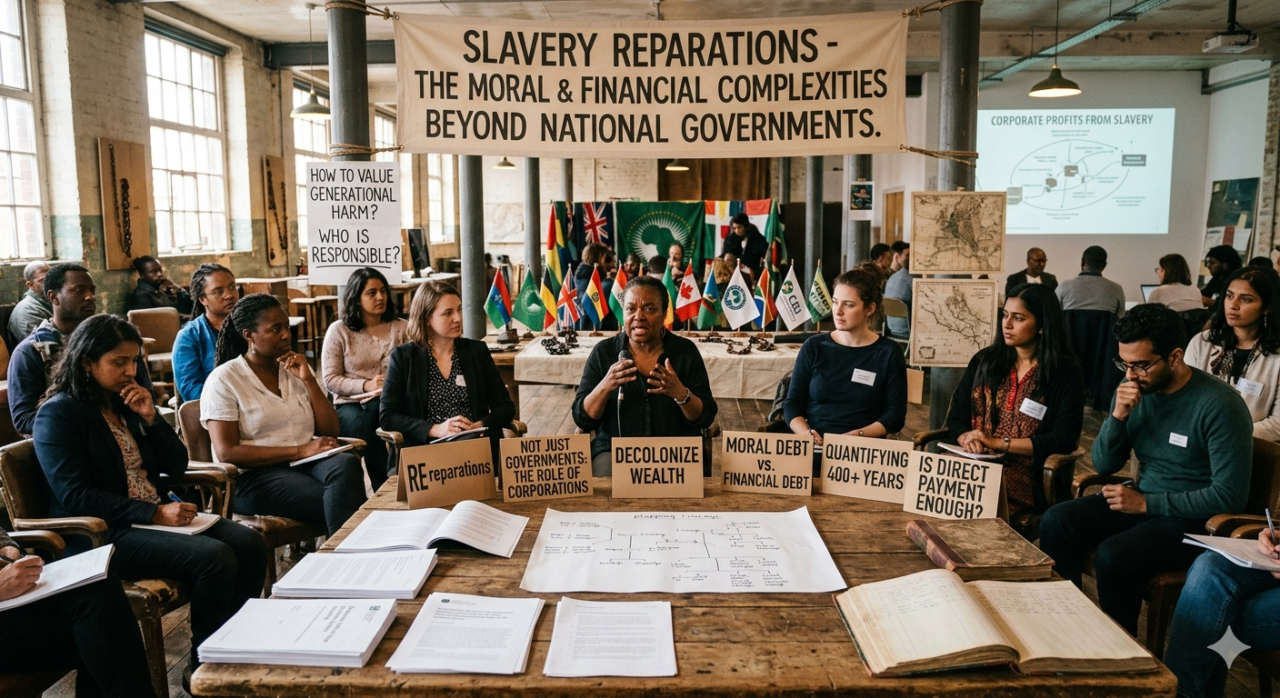
A global debate over slavery reparations has entered a new and consequential phase following a landmark resolution adopted by the United Nations General Assembly on March 25, 2026. While there is growing moral consensus around the need for reparative justice, the question of who exactly owes and who should receive compensation remains deeply complex, shaping diplomatic discussions at the highest levels.
At the center of the conversation is a push led by Ghana and the African Union to define responsibility in a structured and historically grounded way. The issue is no longer framed solely as a moral appeal but as a multidimensional global policy challenge involving governments, institutions, and historical accountability.
On the question of debtors, several layers of responsibility have emerged. European governments—particularly former colonial powers such as the United Kingdom, France, Portugal, and Netherlands—are widely identified as primary actors due to their central role in organizing and profiting from the transatlantic slave trade. In a notable development, Emmanuel Macron signaled in April 2026 a willingness to engage in discussions on reparative justice, marking a potential shift in European engagement with the issue.
The United States is also considered a key debtor by many advocates, given its historical reliance on chattel slavery and the enduring effects of systemic racial inequality. However, the U.S. government remains resistant to formal reparations frameworks and was among only a few countries—alongside Israel and Argentina—that voted against the 2026 UN resolution, citing concerns about retroactive legal liability.
Beyond governments, attention is increasingly turning to corporate and institutional actors that benefited directly from slavery. Financial institutions, insurance firms such as Lloyd’s of London, and even universities are being scrutinized for their historical ties to enslaved labor and the wealth generated from it. Advocates argue that these entities, many of which continue to operate globally, should play a role in funding reparative initiatives.
An emerging and more nuanced dimension of the debate also addresses internal African accountability. Some scholars and policymakers highlight the role of certain African elites and intermediaries who participated in the capture and sale of enslaved people. This perspective raises concerns that if reparations are directed solely to modern governments, the descendants of those most affected—the broader population—may once again be excluded from meaningful benefit.
Equally complex is the question of creditors—those who should receive reparations. One major perspective, championed by organizations such as the CARICOM and various advocacy groups in the United States, emphasizes direct compensation to the descendants of enslaved people. Proposals in the U.S. context include using historical census data and even DNA testing to identify eligible recipients, though such approaches raise practical and ethical challenges.
Another viewpoint, strongly supported by African leaders including John Dramani Mahama, argues that entire nations were systematically impoverished by the transatlantic slave trade and colonial exploitation. From this perspective, reparations should take the form of large-scale developmental support, including debt cancellation, infrastructure investment, and the restitution of cultural artifacts taken during colonial rule.
Ghana’s current advocacy reflects a hybrid approach that seeks to balance these competing perspectives. Officials have emphasized that the goal is not simply financial transfers to governments but “justice for the victims,” focusing on long-term empowerment through education, skills development, and institutional investment. Proposals include the creation of endowment funds, scholarships, and capacity-building programs designed to benefit communities directly impacted by the historical legacy of slavery.
As the global conversation evolves, it is becoming clear that reparations are not a single policy but a complex framework requiring negotiation across legal, historical, and ethical dimensions. The challenge lies not only in acknowledging past injustices but in designing mechanisms that deliver meaningful and equitable outcomes in the present. With the issue now firmly on the international agenda, the coming years are likely to see intensified dialogue, new proposals, and continued debate over how best to address one of history’s most enduring injustices.
Source: Omanghana