Omanghana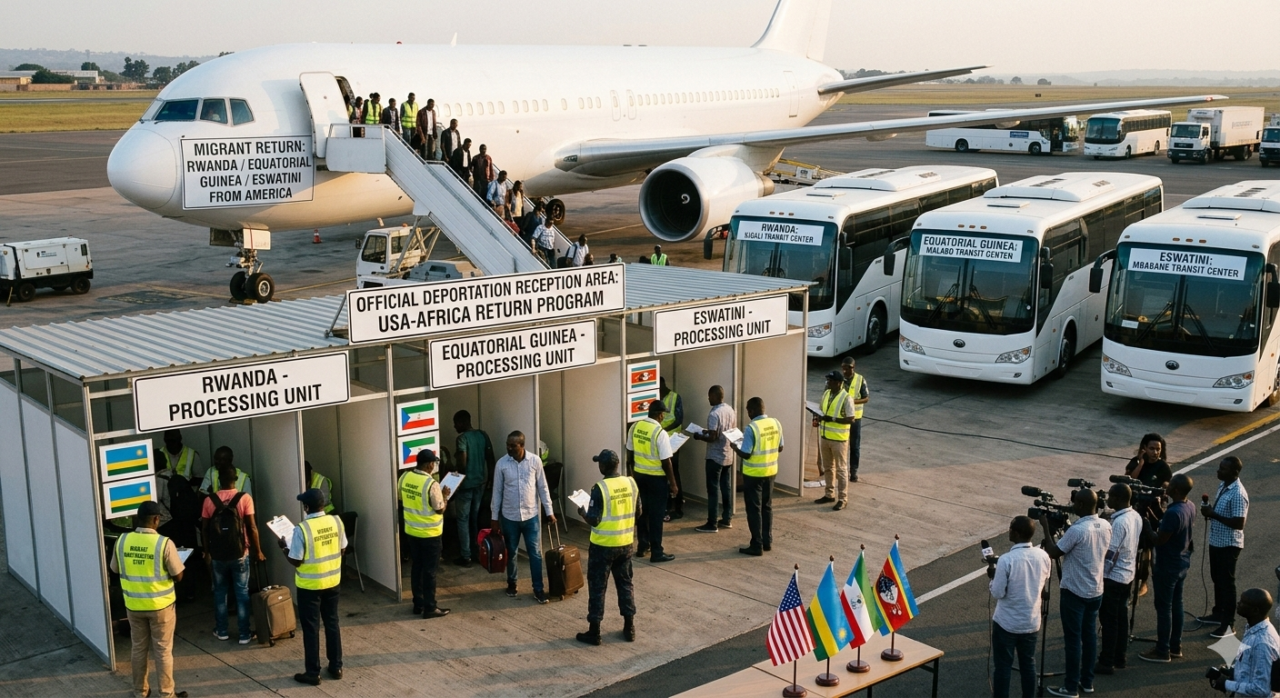
A new report released by the Democrats on the United States Senate Foreign Relations Committee has revealed that the U.S. government paid more than $20 million to three African nations—Rwanda, Equatorial Guinea, and Eswatini—to accept deportees who were not their own citizens.
The findings have sparked debate in Washington over immigration policy, taxpayer spending, and human rights oversight.
Financial and Strategic Breakdown
According to the report, the U.S. disbursed roughly $32 million in direct payments to five countries under what is described as a “third-country removal” framework. Of that amount, more than $20 million went to the three African nations identified as key participants.
Direct Payments to African Countries
-
Equatorial Guinea received approximately $7.5 million to accept 29 deportees.
-
Rwanda received about $7.5 million to take in 7 deportees.
-
Eswatini received roughly $5.1 million for 15 deportees.
When flight operations and logistical expenses are factored in, the per-migrant cost rose sharply. In Rwanda’s case, the total expense reportedly exceeded $1 million per person, including an estimated $601,864 in flight costs for seven individuals.
Beyond direct payments, the broader program cost reached at least $40 million by January 2026, according to the report. This figure includes:
-
Military aircraft operations
-
Security and escort costs
-
Administrative processing
-
Diplomatic arrangements
The use of military aircraft significantly increased operational expenditures.
The program involves transferring migrants to countries that are not their nations of origin. These cases typically involve individuals whom the U.S. government is unable to deport back to their home countries due to:
-
Court-ordered protections
-
Asylum-related legal barriers
-
Lack of diplomatic cooperation
-
Safety concerns in the country of origin
By negotiating financial agreements with third countries, U.S. authorities sought alternative destinations for removal.
The report criticizes the program for what lawmakers describe as limited transparency and oversight.
Key concerns include:
-
Agreements were conducted “largely in the dark.”
-
Minimal congressional review
-
Limited monitoring of how recipient governments use the funds
-
Engagement with governments that have documented human rights challenges
Democratic lawmakers argue that insufficient safeguards raise serious accountability questions.
One of the report’s most controversial findings is that several deportees transferred to third countries were reportedly sent back to their original home countries shortly after arrival.
Critics argue this undermines the stated objective of the program and amounts to a costly detour funded by U.S. taxpayers. Lawmakers described such outcomes as potentially “wasteful” and ineffective.
While Rwanda, Equatorial Guinea, and Eswatini were identified as the largest African recipients, the report indicates that additional countries have engaged in discussions or preliminary frameworks related to similar arrangements. These include:
-
Ghana
-
South Sudan
-
Uganda
-
Cameroon
The nature and scope of those engagements vary and were not detailed to the same extent in the report.
The revelations are likely to intensify debate in Congress over immigration enforcement strategies, fiscal responsibility, and foreign policy ethics. Supporters of third-country removal arrangements argue they provide a practical solution for complex deportation cases. Opponents counter that the high financial cost and potential human rights implications warrant a comprehensive review.
As the issue moves into the broader political arena, lawmakers are expected to push for greater transparency and oversight mechanisms governing future agreements.
Source: Omanghana