Omanghana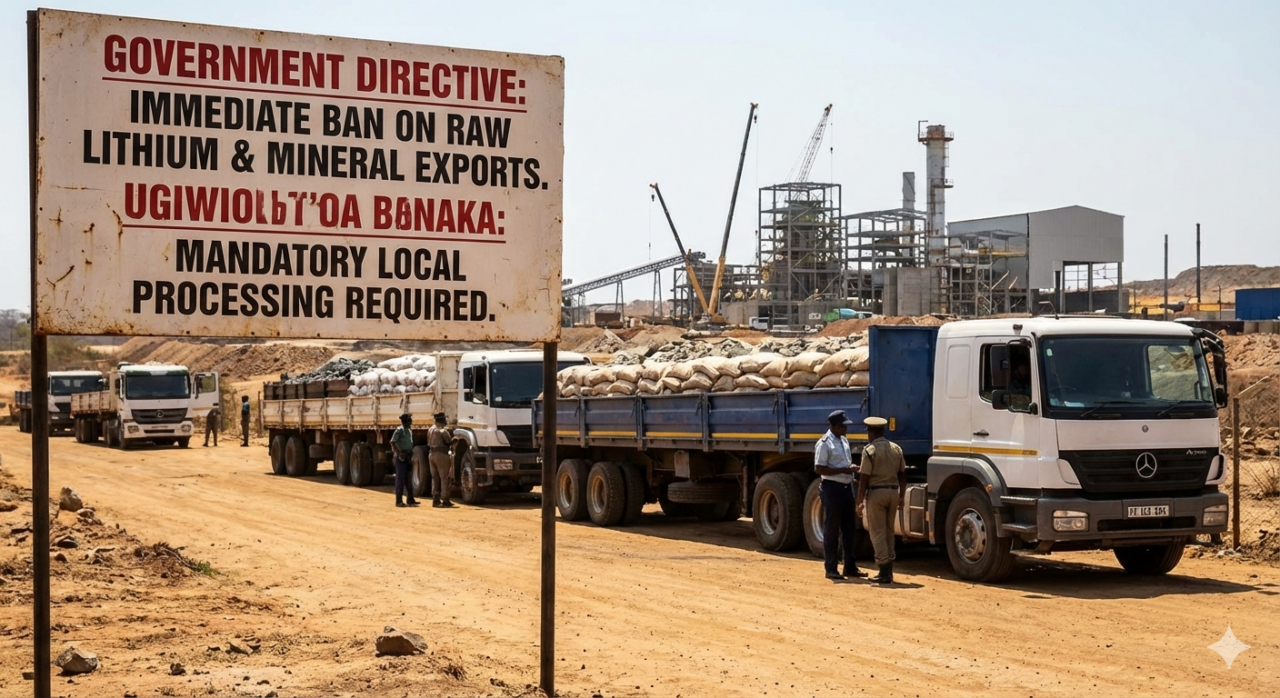
The Government of Zimbabwe has announced an immediate and indefinite ban on the export of all raw minerals and lithium concentrates, effective February 25, 2026, in a decisive move to accelerate domestic mineral beneficiation and retain more value within the national economy.
The directive was confirmed by Mines and Mining Development Minister Polite Kambamura, who said the policy is aimed at compelling mining firms to process and refine minerals locally before export, rather than shipping unprocessed ore abroad.
A Sharp Policy Shift
The export ban represents a significant acceleration of Zimbabwe’s industrial strategy. While authorities had previously signaled plans to phase out lithium concentrate exports by January 2027, the new directive brings that deadline forward by nearly a full year.
Officials say the urgency reflects growing concerns about revenue losses, under-declared exports, and missed opportunities for industrial development.
“Zimbabwe can no longer afford to export jobs and value,” Minister Kambamura said. “Beneficiation is not optional—it is now mandatory.”
Scope of the Ban
According to the ministry, the ban applies broadly and without exceptions:
-
All raw minerals and lithium concentrates are covered
-
Shipments currently in transit are also subject to the directive
-
Export permits for unprocessed minerals are effectively suspended
The government says enforcement agencies have been instructed to tighten border controls and port inspections to ensure compliance.
Targeting Value Leakage
At the core of the policy is an effort to curb what authorities describe as “malpractices and leakages” in the mining sector, including under-invoicing and the export of low-value raw materials that deprive the country of foreign exchange and tax revenue.
By forcing in-country processing, the government aims to:
-
Capture higher export earnings
-
Create skilled industrial jobs
-
Expand downstream manufacturing
-
Strengthen tax and royalty collections
Lithium, a critical input for electric vehicle batteries and energy storage systems, has become one of Zimbabwe’s most strategic minerals amid the global energy transition.
Pressure on Major Mining Firms
The decision places immediate pressure on several foreign mining companies—many of them Chinese-owned—that have invested billions of dollars in Zimbabwe’s lithium sector.
Key players affected include:
-
Zhejiang Huayou Cobalt
-
Sinomine Resource Group
-
Chengxin Lithium Group
These firms will now be required to fast-track the construction of local processing and refining facilities if they wish to continue exporting lithium products.
Industry sources say some companies had already begun preliminary work on refineries, but the new timeline will require accelerated capital spending and regulatory approvals.
Regional and Global Context
Zimbabwe’s move mirrors similar policies adopted by other resource-rich countries seeking to move up the mineral value chain. Governments across Africa and Latin America have increasingly restricted raw mineral exports to stimulate local industry and reduce dependence on commodity exports.
Analysts note that Zimbabwe holds some of the largest lithium reserves in Africa, making its policy choices particularly significant for global battery supply chains—especially as demand from China, Europe, and the United States continues to surge.
Industry Reaction and Outlook
While the mining sector has expressed concern about the abrupt nature of the ban, government officials insist the policy was clearly signaled and that serious investors should already be preparing for beneficiation.
In the short term, analysts expect disruptions to export volumes and potential legal disputes. Over the medium to long term, however, the government believes the policy will transform Zimbabwe from a raw material supplier into a regional hub for lithium processing.
As enforcement begins, the export ban marks one of the boldest resource nationalism moves in Zimbabwe’s mining history—one that could reshape the country’s economic trajectory if successfully implemented.
Source: Omanghana