Omanghana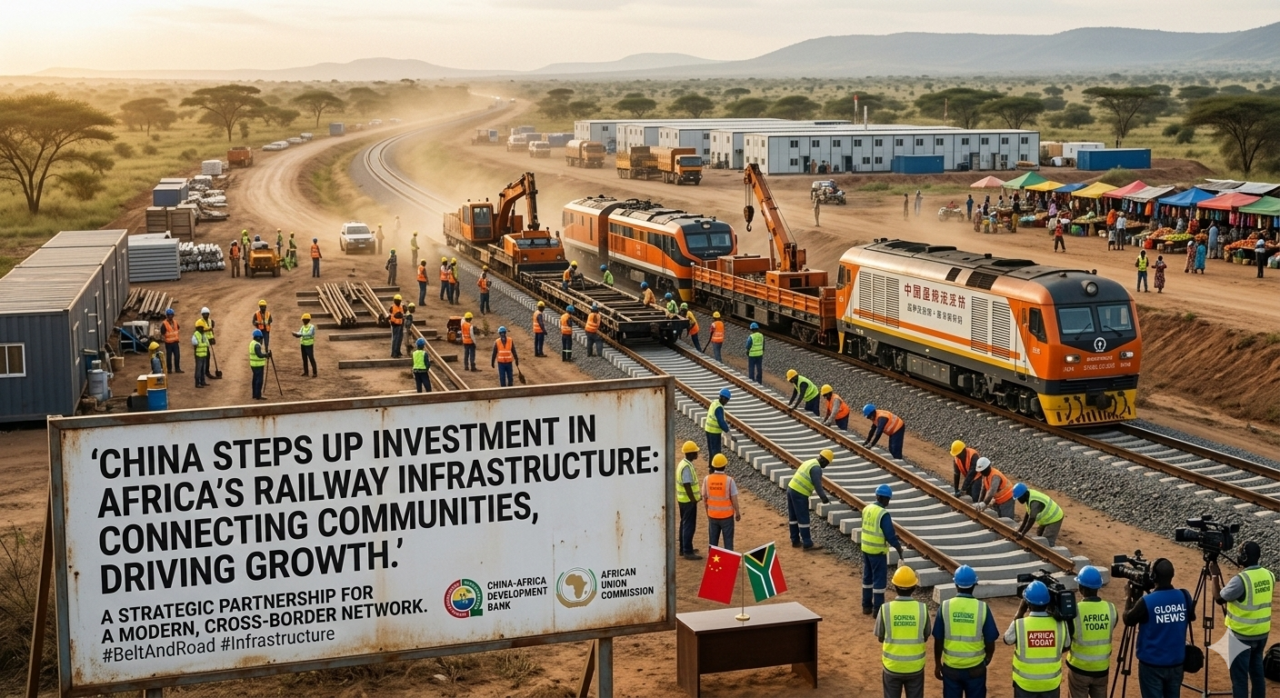
China is significantly increasing its investment in railway infrastructure across Africa as part of a broader strategy to secure supply chains for critical minerals such as copper, cobalt, and nickel. The push comes amid growing geopolitical competition with Western-backed infrastructure projects, including the Lobito Corridor supported by the United States and its partners.
One of the most notable projects is the revitalization of the TAZARA Railway, which links Zambia’s Copperbelt mining region to the port of Dar es Salaam in Tanzania. The project involves an investment of more than $1.4 billion from China Civil Engineering Construction Corporation. Under the agreement, the company will rehabilitate and operate the 1,860-kilometre railway under a 30-year concession before transferring it back to the host governments. The modernization includes the delivery of 34 new locomotives, 16 passenger coaches, and about 760 freight wagons.
Another major rail project is the planned Tanzania–Burundi–DRC Standard Gauge Railway, a $2.15 billion project awarded to a Chinese consortium. The railway aims to connect Dar es Salaam with mineral-rich regions in Burundi and the Democratic Republic of the Congo, particularly areas known for nickel and other strategic resources.
In Kenya, China has also played a key role in the development of the Standard Gauge Railway (Kenya). Operations of the railway are gradually being transferred to Kenya Railways, with more than 90 percent of operations already handed over to local management.
Analysts say the expansion of rail infrastructure is closely tied to global competition for critical minerals used in modern technologies, including batteries and renewable energy systems. China currently processes more than 90 percent of the world’s graphite and a large share of global cobalt and lithium supplies. Efficient rail networks are therefore essential for transporting these minerals from inland mining regions to ports for export.
The investments also highlight increasing geopolitical competition in Africa. China’s rail and port projects along the Indian Ocean, such as the TAZARA route, are seen as competing with Western-supported corridors along the Atlantic coast, including the Lobito Corridor.
In recent years, China’s approach to infrastructure financing in Africa has also evolved. Instead of purely aid-driven projects, many investments now follow profit-oriented models, including long-term concessions and resource-backed loans sometimes referred to as the “Angola model.” Major financing for these projects often comes from institutions such as the Export-Import Bank of China and the China Development Bank.
However, the growing wave of Chinese-funded infrastructure has also raised concerns. Some countries, including Zambia and Kenya, face high debt burdens linked to large infrastructure loans, prompting debates about financial sustainability and allegations of “debt-trap diplomacy.” There have also been social concerns in some regions over the use of Chinese labor and the displacement of local communities during railway construction.
Source: Omanghana