Omanghana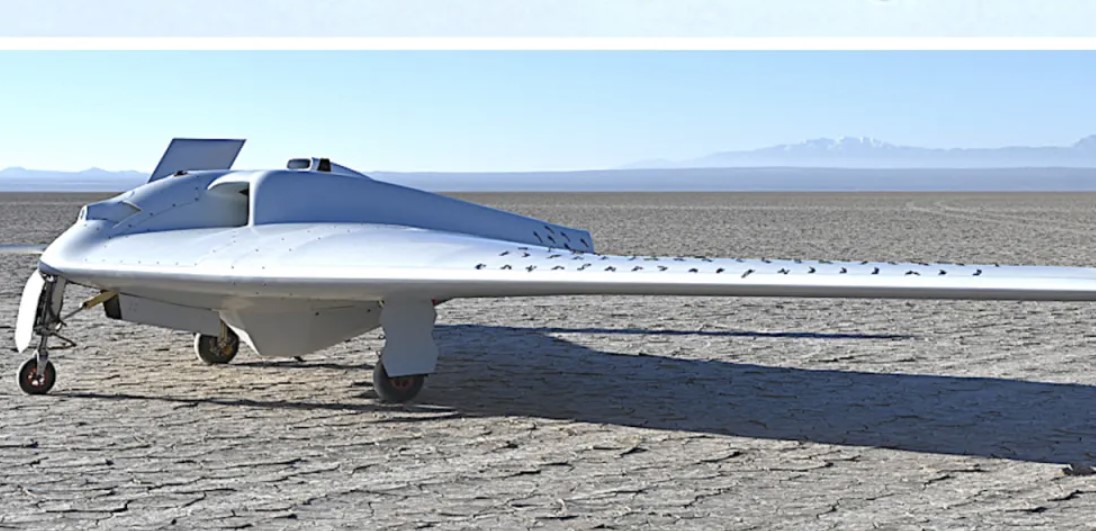
Defense Advanced Research Projects Agency has confirmed the successful maiden flight of its experimental XRQ-73 hybrid-electric flying wing drone, marking a major milestone in the development of next-generation stealth and energy-efficient military aircraft.
The flight took place at Edwards Air Force Base in April 2026, although the achievement was only officially announced by DARPA on May 6. Analysis of imagery released alongside the announcement suggests the test flight likely occurred on April 14.
The XRQ-73 was developed under DARPA’s SHEPARD program, short for Series Hybrid Electric Propulsion AiRcraft Demonstration. The initiative forms part of the agency’s “X-prime” development model, which focuses on rapidly transforming emerging technologies into operational military systems.
The aircraft features a series hybrid-electric propulsion architecture in which a gas turbine generates electricity that powers electric motors rather than directly driving propulsion systems. DARPA says the design significantly reduces acoustic signatures, enabling ultra-quiet operation suitable for stealth intelligence, surveillance, and reconnaissance missions.
Built by Northrop Grumman and its subsidiary Scaled Composites, the XRQ-73 is a tailless flying wing unmanned aircraft categorized as a Group 3 UAS. The drone weighs approximately 1,250 pounds and is designed to test advanced propulsion and operational concepts for future military aviation platforms.
The program also draws on technology and research from the secretive Great Horned Owl project, previously managed by the Intelligence Advanced Research Projects Activity and the Air Force Research Laboratory.
According to DARPA, the XRQ-73 could help redefine future aircraft design by improving fuel efficiency, reducing operational noise, and increasing mission flexibility. The hybrid-electric framework is also expected to support high-energy payloads in future variants, including advanced surveillance systems and potentially directed-energy weapons.
Defense analysts view the successful test as part of a broader push by the United States military to explore electric and hybrid-electric propulsion technologies that could provide tactical advantages in contested environments while lowering logistical demands and operational costs.
Source: Omanghana