Omanghana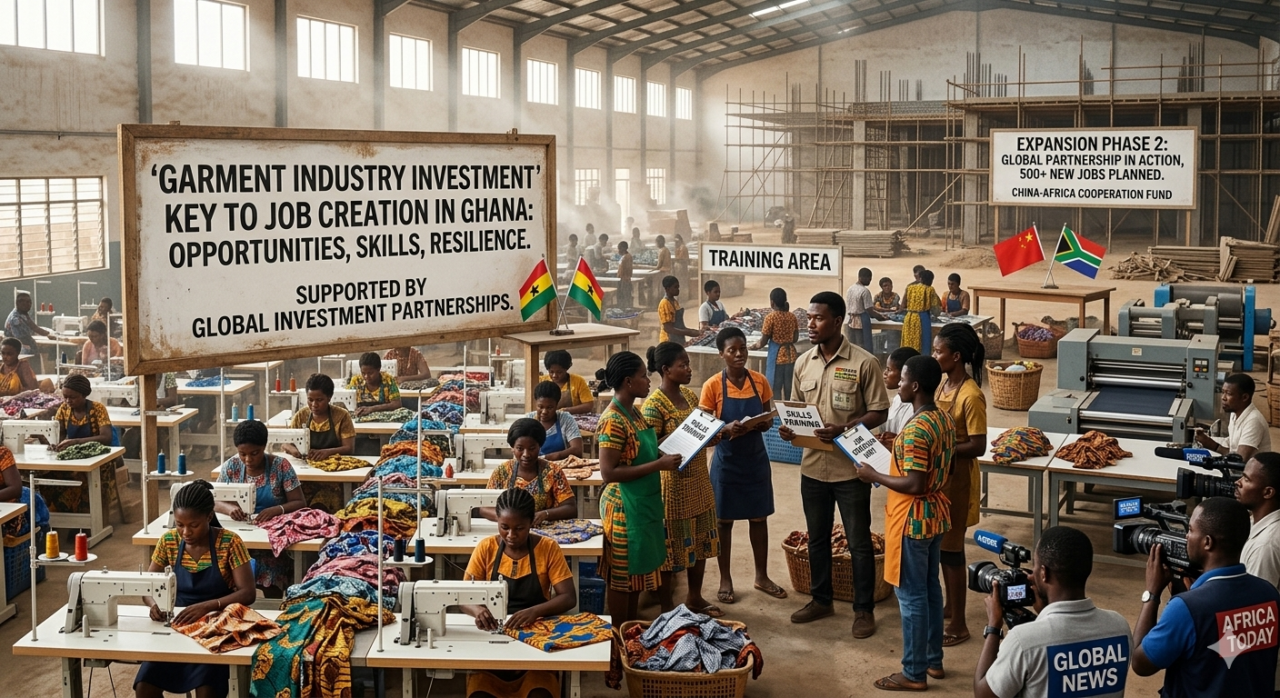
Global textile expert Rajesh Golani has emphasized that strategic investment in Ghana’s garment industry could unlock large-scale job creation and drive industrial growth in the country.
According to Golani, Ghana has several competitive advantages that position it well for expansion in the global textile and apparel market. One major advantage is the country’s access to international markets through trade agreements with the United States, Europe, and other African partners. This market access allows Ghanaian manufacturers to export garments to major global markets with fewer trade barriers.
Golani also noted that the introduction of a shift-based production system under the government’s 24-Hour Economy Policy could significantly increase employment. Under such a model, factories could operate three shifts per day. For example, a garment factory that currently employs about 2,500 workers on a single shift could potentially expand to around 7,500 workers if production runs continuously.
Another strategic advantage is Ghana’s role as host of the African Continental Free Trade Area Secretariat in Accra, which positions the country to play a leading role in Africa’s growing garment and textile value chain.
The government has outlined an ambitious plan to revive and expand the textile and garment sector. The strategy aims to attract about $1.2 billion in new investment for garment factories and industrial parks. Authorities hope this expansion will create about 150,000 direct and indirect jobs between 2030 and 2033 while growing the sector into a $2 billion industry by 2033.
Plans also include developing five modern industrial parks and revitalizing about 50,000 hectares of cotton farming to strengthen local raw material supply for the textile industry.
As part of the effort, the government intends to support private sector investors to establish three large garment factories in the Central, Bono East, and Eastern regions. These factories are expected to generate approximately 27,000 jobs.
International partners are also supporting the initiative. The International Finance Corporation has partnered with DTRT Apparel Group to expand garment manufacturing capacity in Ghana, a move expected to create more than 6,000 additional jobs.
Meanwhile, the International Labour Organization has encouraged government institutions to increase procurement of locally produced garments in order to reduce the country’s current dependence on imports, which account for about 70 percent of garments used in Ghana.
Despite the opportunities, industry experts say several challenges remain. Ghana still imports a large share of its fabric from Asian markets, even though high-quality organic cotton is produced in West Africa. Manufacturers also face high electricity costs and expensive borrowing rates, which can range from 32 to 45 percent. In addition, there is a shortage of skilled management professionals and specialized training programs needed to support a modern garment industry.
Source: Omanghana