Omanghana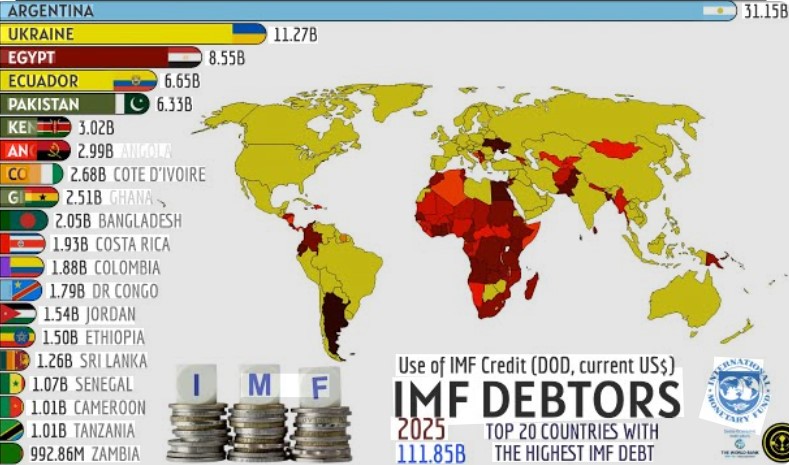
Argentina remains the largest debtor to the International Monetary Fund (IMF), with more than $60 billion in outstanding credit as of April 2026. This figure is roughly four times higher than that of the next most indebted country, highlighting Argentina’s long history of economic instability and repeated reliance on IMF bailout programs.
Overall, the IMF’s total outstanding credit currently stands at about $162 billion, with a relatively small group of countries accounting for a significant share of that total.
Behind Argentina, Ukraine ranks second with approximately $15.5 billion in debt, followed by Egypt at $10.7 billion and Pakistan at $10.5 billion. Ecuador rounds out the top five with about $10.1 billion in outstanding loans.
Several African countries also feature prominently among the IMF’s largest borrowers. Côte d’Ivoire owes around $5.2 billion, while Kenya and Bangladesh each hold about $4.2 billion in debt. Ghana follows with roughly $3.9 billion, and Angola closes the top ten with about $3.5 billion.
While Argentina leads in absolute terms, Suriname has the highest IMF debt relative to the size of its economy, with obligations estimated at around 13 percent of its gross domestic product.
Ukraine’s rising debt reflects the economic strain caused by its ongoing conflict with Russia, which has increased its reliance on international financial support.
Across Africa, borrowing from the IMF remains widespread. A total of 48 African countries currently hold IMF credit, with combined debt estimated at about $42.2 billion—roughly one-third of the institution’s total outstanding loans.
Some countries have made progress in reducing their debt levels. Egypt, for example, lowered its IMF obligations from $14.9 billion in early 2024 to $10.7 billion by April 2026, although it still remains one of the fund’s largest borrowers.
The data highlights the continued role of the IMF as a key financial lifeline for countries facing economic challenges, while also underscoring the long-term debt burdens that can result from repeated reliance on international assistance.
Source: Omanghana