Omanghana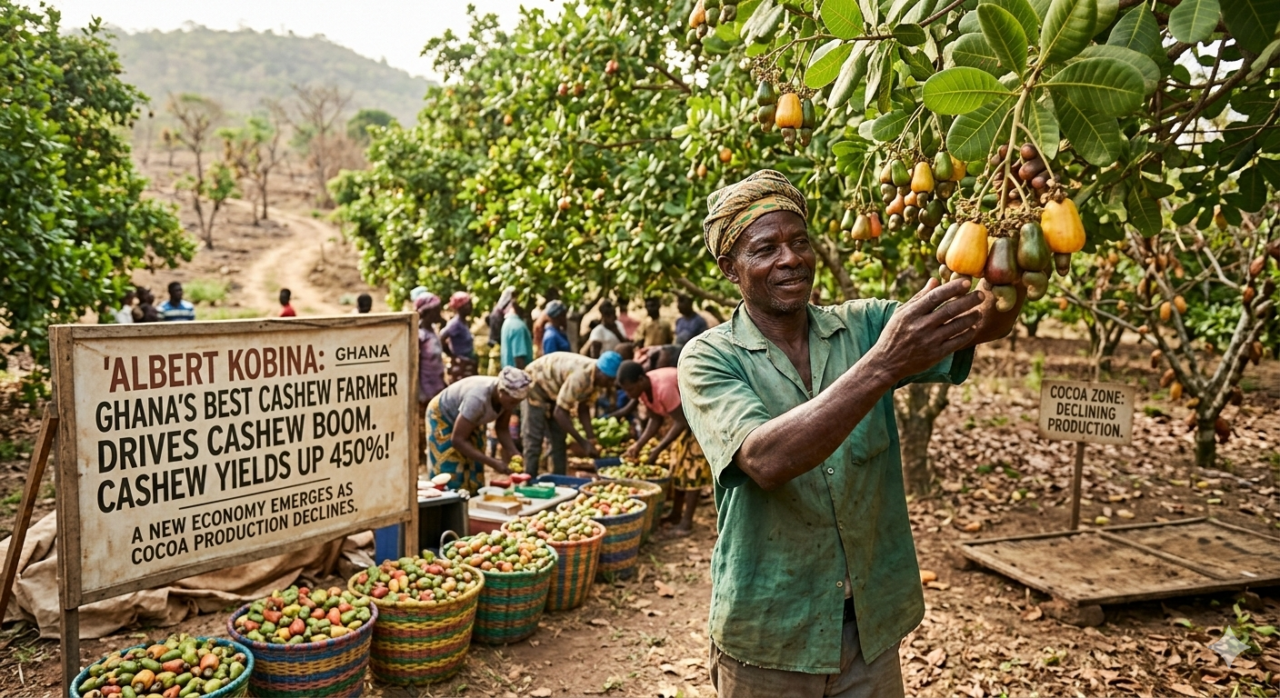
The cashew boom in Ghana is gaining momentum, driven by innovative farmers such as Yahya Iddrisu, who are shifting away from the country’s struggling cocoa sector. As cocoa production continues to decline sharply, cashew is emerging as a more resilient and profitable alternative in the face of climate change and economic uncertainty.
In recent seasons, Ghana’s cocoa output has dropped to roughly 650,000 to 700,000 tonnes, compared to historical peaks of over one million tonnes. The decline has been linked to ageing cocoa trees, widespread disease, climate stress, and broader financial challenges within the sector. For many farmers, the traditional backbone of Ghana’s agricultural economy is no longer as dependable as it once was.
Cashew, however, is proving to be a reliable source of income. Its hardier nature makes it more resistant to erratic rainfall and prolonged dry spells, offering farmers greater stability at a time when cocoa yields are falling. The crop’s growing demand in international markets has also strengthened its appeal.
One notable innovation gaining attention is a system known as “Cash-Co Farming,” where cocoa is planted under the shade of cashew trees. Farmers like Iddrisu have demonstrated that cocoa can survive and even benefit from the protective canopy provided by cashew. This dual-cropping approach allows farmers to diversify their income while maintaining cocoa production. The Ghana Cocoa Board (COCOBOD) has reportedly supported this model by providing free cocoa seedlings to farmers adopting the system.
Cashew farming is also delivering environmental benefits. Expanding plantations are helping to reduce bushfires by replacing dry grasslands that previously fueled frequent seasonal fires. The presence of cashew trees creates a more stable landscape and lowers the risk of uncontrolled burns.
Market activity around cashew is expanding rapidly. Buyers now travel directly to farms using tricycles equipped with mobile weighing scales, allowing farmers to sell their produce at the farm gate. This has reduced transport costs and made transactions more convenient and transparent.
Meanwhile, Ghana’s cocoa sector remains under significant strain. Production has fallen by nearly 50 percent over the past three years, with analysts pointing to mismanagement, debt challenges, and environmental pressures as key factors. COCOBOD’s outstanding debt is estimated at around GH₵32 billion, with substantial repayments due in 2025 and 2026, adding further pressure to the industry.
Despite record-high international cocoa prices, many West African cocoa farmers continue to struggle financially, earning between $0.78 and $1.00 per day—well below the global extreme poverty line. Against this backdrop, the rise of cashew farming represents not just an agricultural shift but a survival strategy for thousands of rural households seeking stability in uncertain times.
Source: Omanghana