Omanghana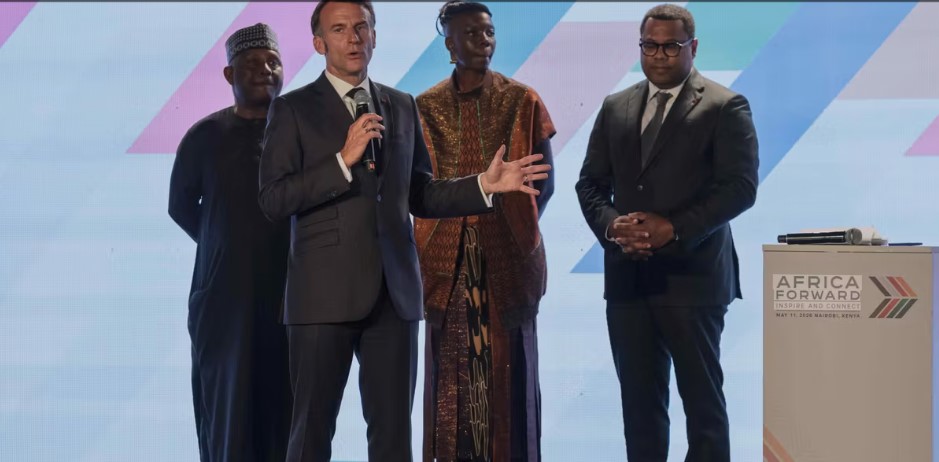
French President Emmanuel Macron is facing mounting international criticism following a tense moment at the Africa Forward Summit in Nairobi, where he abruptly interrupted a youth-focused panel discussion to demand silence from the audience. The incident, which quickly spread across social media platforms, has triggered accusations of arrogance, paternalism, and lingering colonial attitudes toward African nations.
The confrontation occurred during a session featuring young African entrepreneurs, creatives, and artists at the summit. Witnesses said Macron appeared visibly frustrated by background chatter in the audience before stepping onto the stage, taking a microphone from one of the speakers, and condemning the noise as a “total lack of respect.” He reportedly instructed disruptive attendees to either move into bilateral meeting rooms or leave the venue entirely.
Videos of the exchange rapidly went viral online, sparking widespread debate across Africa and Europe. Critics from African civil society groups and political commentators described the French president’s behavior as condescending and overly authoritative. Many observers compared the moment to “a schoolteacher scolding children,” arguing that the incident reinforced long-standing concerns about whether France truly sees African nations as equal diplomatic partners.
The backlash intensified after French opposition politicians also condemned Macron’s conduct. Danièle Obono, a lawmaker from the left-wing party La France Insoumise, criticized the president on social media, accusing him of behaving “like a colonizer” during visits to the African continent. Her remarks fueled broader discussions about France’s historical relationship with Africa and the continued sensitivity surrounding its post-colonial influence in the region.
Controversy surrounding the summit was further amplified by separate comments Macron made during a press conference, where he reportedly described himself as a “true Pan-Africanist.” The statement drew immediate criticism from activists and scholars who argued that Pan-Africanism historically emerged as a movement resisting colonial domination and foreign control.
Farida Nabourema, a prominent Togolese human rights advocate, issued a public response rejecting Macron’s characterization. In an open letter, she argued that Pan-Africanism is fundamentally incompatible with the legacy of French colonialism and France’s historical role in African political affairs. Her comments gained significant traction online among Pan-African activists and commentators.
The diplomatic controversy comes at a sensitive geopolitical moment for France’s African strategy. Analysts note that Paris has increasingly been attempting to strengthen ties in East Africa following a series of diplomatic and military setbacks in West Africa, particularly in countries such as Mali, Burkina Faso, and Niger, where French influence has sharply declined amid the rise of alternative security partnerships involving Russia.
As part of France’s renewed engagement effort, Macron used the summit to announce a major $27 billion investment initiative targeting infrastructure development across Africa. The proposed funding package focuses on sectors including energy, artificial intelligence, and agriculture, and is intended to rebuild economic trust and deepen cooperation between France and African nations.
However, political analysts warn that the controversy surrounding Macron’s remarks and behavior in Nairobi may complicate France’s broader diplomatic outreach efforts at a time when African public opinion is increasingly skeptical of traditional Western influence on the continent.
Source: Omanghana