Omanghana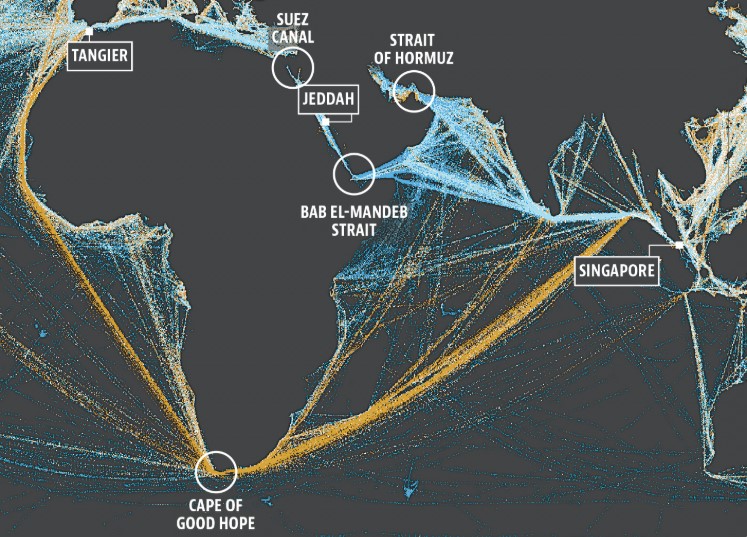
Global shipping patterns are undergoing a major shift as rising tensions in the Middle East push companies away from the Suez Canal toward the longer route around southern Africa via the Cape of Good Hope. By May 1, 2026, an estimated 70 percent of freight that previously passed through the Red Sea had been rerouted, marking one of the most significant disruptions to global trade routes in recent years.
The diversion has been driven by the closure of the Strait of Hormuz and ongoing security risks in the Red Sea following military activity earlier in 2026. Faced with these risks, major global carriers such as Maersk, CMA CGM, and Hapag-Lloyd have suspended operations through the Suez Canal corridor, choosing more stable routes despite the added time and cost.
Rising insurance premiums have further accelerated the shift, with war risk coverage either becoming prohibitively expensive or unavailable altogether for vessels transiting high-risk zones. As a result, the Cape route has seen a dramatic increase in activity, with commercial traffic around Africa more than tripling since 2023. By late April 2026, shipping volumes around the Cape of Good Hope reached a record 24 million deadweight tonnes, while traffic through the Bab al-Mandeb Strait into the Suez Canal dropped by more than 70 percent.
The rerouting comes with significant logistical and financial implications. Voyages between Asia and Europe are now extended by roughly 4,000 nautical miles, adding between 10 and 18 days to delivery times. Fuel consumption has increased by 30 to 50 percent, and container shipping rates on some routes have surged by as much as 300 percent.
At the same time, the shift is creating new economic opportunities for African ports. Facilities such as Tanger Med in Morocco, Walvis Bay in Namibia, and various South African service hubs are experiencing a boom in refueling, maintenance, and offshore logistics services as more vessels pass along the continent’s coastline.
However, the impact has been deeply negative for Egypt, which relies heavily on Suez Canal revenues. The country has seen earnings from the canal drop by more than 60 percent—an estimated $7 billion loss compared to 2023—due to the sharp decline in vessel traffic.
The ongoing disruption highlights how geopolitical instability in key maritime chokepoints can rapidly reshape global trade flows, with ripple effects felt across continents, industries, and economies.
Source: Omanghana