Omanghana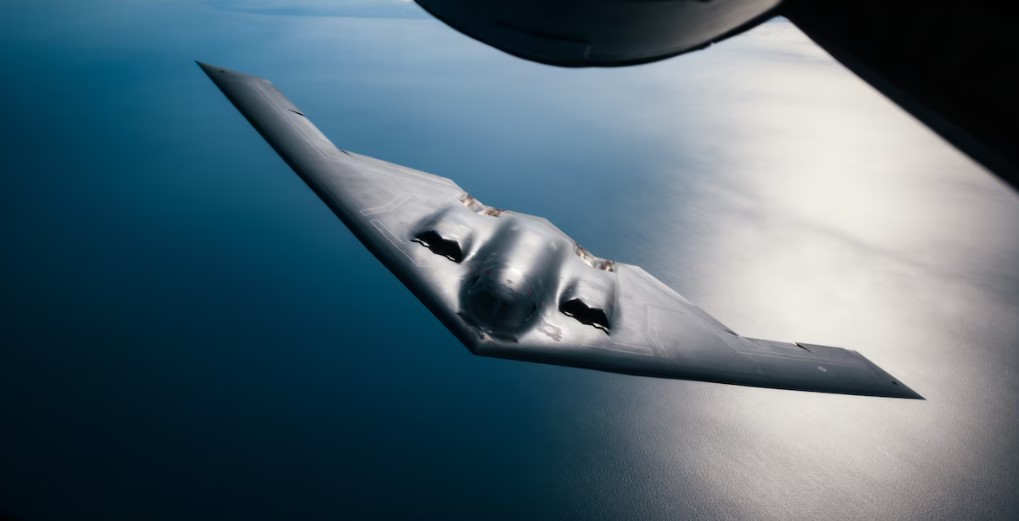
The United States Air Force and the United States Navy carried out a high-profile maritime strike exercise off the coast of California, showcasing a new level of integration between stealth bombers and carrier-based aviation.
The drill paired the B-2 Spirit with Carrier Air Wing 11, signaling a significant evolution in joint force operations aimed at countering advanced maritime threats in highly contested regions.
Central to the exercise was the operational debut of the AIM-174B “Gunslinger,” an ultra-long-range air-to-air missile developed from the Navy’s ship-launched SM-6 platform.
Adapted for air launch, the AIM-174B dramatically expands the engagement envelope of the Navy’s F/A-18E/F Super Hornet, potentially enabling it to strike targets at ranges exceeding 300 miles. This capability allows carrier-based fighters to hold enemy aircraft, surveillance platforms, and even certain maritime targets at risk from well beyond traditional combat distances.
Military planners view the missile as a strategic answer to adversaries developing longer-range anti-ship and anti-aircraft systems.
The exercise also highlighted a sophisticated networked warfare concept often referred to as a “kill web.”
In this architecture:
-
The B-2 Spirit penetrates contested airspace using its stealth profile to identify or cue targets.
-
The Navy’s F-35C Lightning II provides advanced sensor fusion and real-time battlefield data.
-
Super Hornets armed with the AIM-174B execute long-range strikes from standoff distances.
Rather than operating as isolated platforms, each aircraft becomes a node in a larger combat network—sharing targeting data across air, sea, and potentially space-based systems. This approach increases survivability while maximizing strike effectiveness.
The integration directly addresses the growing challenge of Anti-Access/Area-Denial (A2/AD) systems deployed by near-peer competitors. Such defenses—ranging from advanced surface-to-air missiles to long-range anti-ship weapons—are designed to keep U.S. forces at a distance.
By combining stealth bombers with carrier-based fighters equipped with extended-range munitions, the U.S. military aims to out-range, disrupt, and neutralize sophisticated coastal defense networks and high-value enemy assets without exposing strike groups to excessive risk.
Defense analysts say this layered approach enhances deterrence, particularly in regions like the Indo-Pacific, where contested maritime zones are central to strategic competition.
As of March 1, 2026, similar assets—including B-2 Spirit bombers and carrier-based strike groups—have reportedly been mobilized for Operation Epic Fury in the Middle East.
B-2 bombers operating from Whiteman Air Force Base have joined the air campaign, targeting hardened underground facilities. The deployment underscores how capabilities demonstrated during training exercises can rapidly transition into real-world operational roles.
The February maritime strike exercise signals a broader transformation in U.S. power projection. By integrating stealth platforms, advanced sensors, and ultra-long-range weapons into a seamless operational network, the United States is positioning itself to maintain air and maritime dominance in increasingly contested theaters.
As global tensions evolve, the fusion of strategic bombers and carrier aviation may become a defining feature of modern warfare—reshaping how deterrence and combat operations are executed in the 21st century.
Source: Omanghana