Omanghana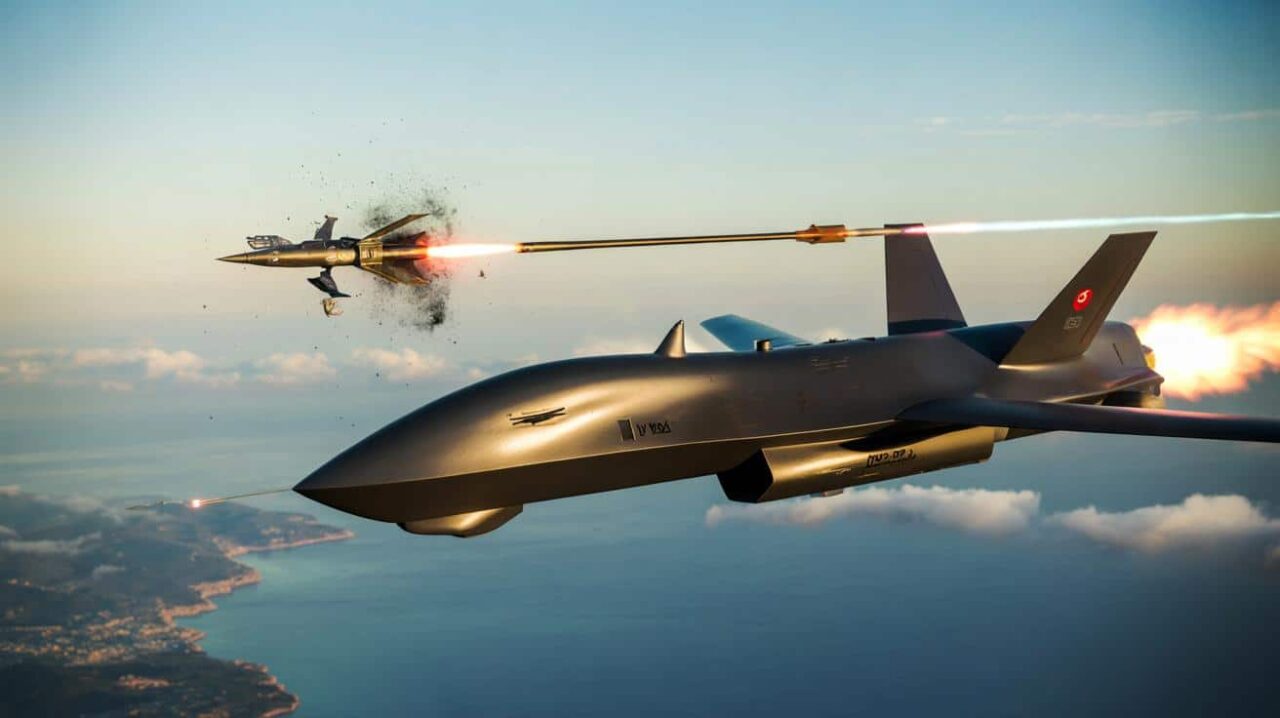
Turkey has achieved a breakthrough in global military aviation after its indigenous unmanned combat aerial vehicle (UCAV), Bayraktar Kızılelma, became the first uncrewed aircraft in history to detect, track, and shoot down a high-speed jet-powered aerial target using a radar-guided missile.
The milestone marks a fundamental shift in drone warfare, expanding uncrewed systems from traditional reconnaissance and air-to-ground strike roles into full air-to-air combat.
The achievement occurred during a live-fire test off the coast of Sinop in late November 2025, where the Kızılelma successfully engaged and destroyed a jet-powered target drone in flight.
Defense analysts say the test represents the first verified example of a UCAV executing a beyond-visual-range (BVR) air-to-air engagement without human control of the firing sequence.
Crucially, the operation relied on a completely Turkish-developed mission chain, underscoring Ankara’s growing technological self-sufficiency in advanced defense systems:
-
The UCAV: The Bayraktar Kızılelma, developed by Baykar, is a jet-powered, fighter-like unmanned aircraft designed for high-speed and carrier-capable operations.
-
The Radar: Autonomous target detection and tracking were provided by Aselsan’s MURAD AESA radar, enabling the drone to identify and engage threats independently.
-
The Missile: The target was destroyed using the Gökdoğan, a beyond-visual-range air-to-air missile developed by TÜBİTAK SAGE.
Military experts say integrating radar, missile, and autonomous decision-making into an uncrewed platform represents one of the most complex challenges in modern air combat—and Turkey has now crossed that threshold.
The test also validated the concept of Manned–Unmanned Teaming (MUM-T). During the engagement, the Kızılelma flew in coordinated formation with five F-16 fighter jets, simulating future combat scenarios in which autonomous aircraft operate alongside human pilots.
Defense planners see this model as central to next-generation air forces, allowing unmanned systems to take on high-risk missions while crewed aircraft retain command and strategic oversight.
Until now, combat drones have largely been confined to surveillance and ground-attack missions. The Kızılelma’s successful air-to-air engagement signals a doctrinal shift, proving that autonomous systems can contest and control airspace.
Turkey is now regarded as the first country to publicly verify BVR air-to-air combat capability on an uncrewed platform, placing it at the forefront of autonomous aerial warfare.
The achievement builds on a string of aviation milestones reached by Turkey in early 2026:
NATO Exercise Debut
In February 2026, the Bayraktar TB3 successfully conducted live-fire missions and autonomous takeoffs and landings aboard the amphibious assault ship TCG Anadolu during NATO’s Steadfast Dart 2026 in the Baltic Sea. It marked the first participation of a shipborne UCAV in a NATO drill.
All-Weather Autonomous Operations
Notably, the TB3 was the only aircraft able to operate during severe winter conditions, including heavy snowfall and temperatures around –5°C, while crewed jets and helicopters were grounded—highlighting the operational advantages of autonomous platforms in extreme environments.
Together, these milestones underscore Turkey’s rapid ascent as a global leader in uncrewed and autonomous military aviation. By mastering air-to-air combat, carrier operations, and NATO interoperability, Turkish defense systems are redefining what drones can do in modern warfare.
As militaries worldwide rethink the future of air combat, the Bayraktar Kızılelma’s historic shootdown may well be remembered as the moment uncrewed fighters truly arrived.
Source: Omanghana