Omanghana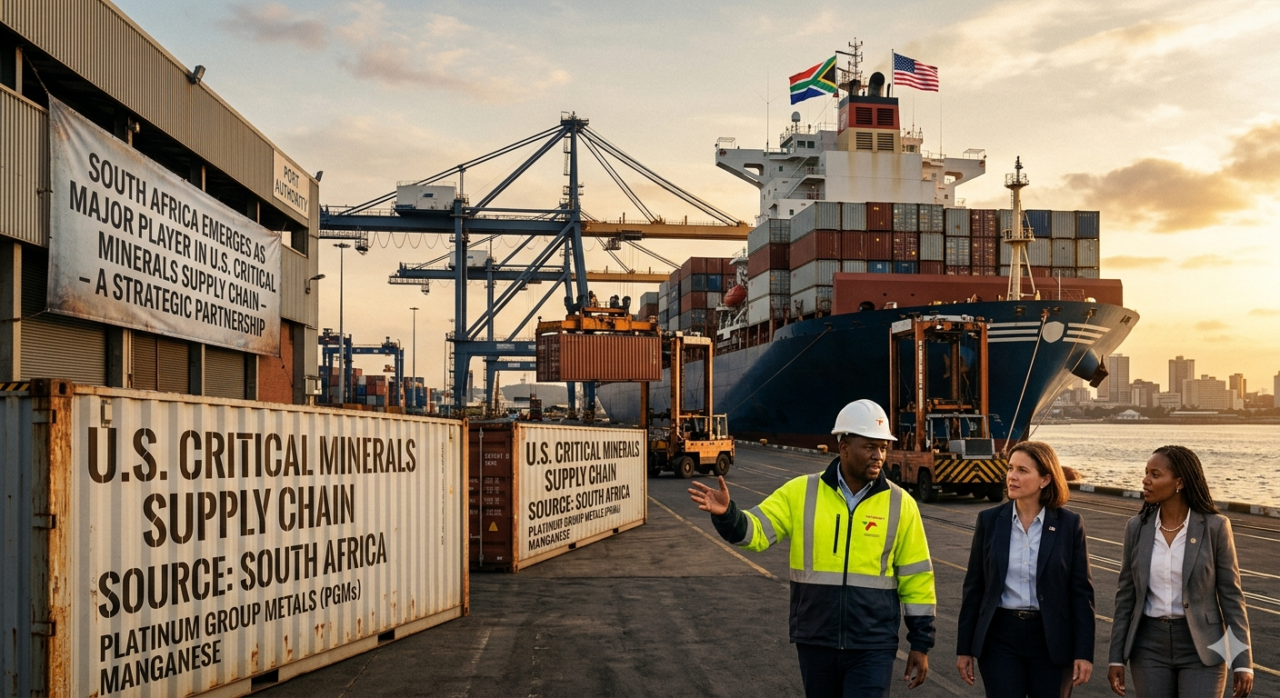
South Africa has reinforced its role as a critical partner in the United States’ supply chain for essential minerals, providing key resources that support defense systems, clean energy technologies, and advanced manufacturing industries.
The country is a leading supplier of several minerals on which the United States heavily depends. Among them is chromium, with South Africa accounting for nearly all U.S. imports. This mineral is vital for stainless steel production, used in infrastructure and defense applications. South Africa also dominates the global supply of platinum group metals, including platinum, palladium, and rhodium. These materials are indispensable for technologies such as catalytic converters, hydrogen fuel cells, and semiconductor manufacturing.
Manganese is another crucial export, with South Africa recognized as the world’s largest producer and a major supplier to the U.S. The mineral plays an essential role in steel production and is increasingly important for next-generation electric vehicle batteries. In addition, South Africa has become a key source of vanadium, particularly for military-grade applications. By 2026, its share of U.S. imports of this material had risen significantly, supporting its use in armored vehicles, missile casings, and jet engines.
Recent developments are further strengthening South Africa’s position in the global minerals market. The country has seen growing activity in rare earth exploration, ranking among the top globally in 2025. Notable projects such as the Steenkampskraal deposit and the Phalaborwa Rare Earths Project, expected to come online in 2026, are set to expand supply and diversify mineral output.
The United States has also increased its financial engagement to secure access to these resources. Billions of dollars in potential funding, including support from the U.S. International Development Finance Corporation, are being directed toward strengthening supply chains and supporting local refining capacity in South Africa.
A key advantage for South Africa lies in its established industrial base. With decades-old smelting and refining infrastructure, the country is well-positioned to develop into a regional processing hub. Efforts are underway to expand this capacity, reducing reliance on external processing markets and adding value to raw mineral exports.
However, challenges remain. Energy constraints, particularly ongoing power shortages, and logistical bottlenecks in rail transport continue to affect supply reliability. Reforms aimed at opening rail networks to third-party operators are expected to ease these constraints and improve freight capacity.
At the same time, regulatory changes are reshaping the sector. New policies introduced under recent mining legislation grant the government greater authority over designated minerals, including the ability to require local processing before export. These measures are intended to boost domestic value addition while maintaining South Africa’s strategic importance in global supply chains.
Source: Omanghana