Omanghana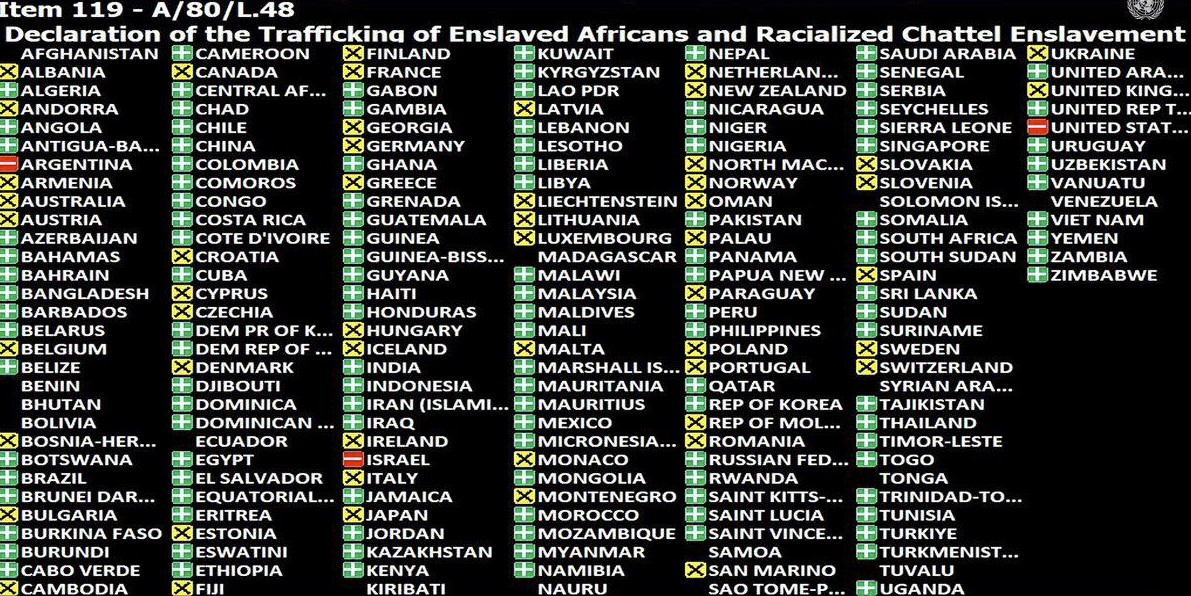
The United Nations General Assembly has officially adopted a landmark resolution declaring the transatlantic trafficking and enslavement of Africans as the gravest crime against humanity, marking a significant moment in the global movement for historical accountability and justice.
The resolution, led by Ghana and backed by the African Union, represents a major step forward in ongoing calls for reparatory justice. Although resolutions of the General Assembly are not legally binding, they carry substantial political and moral influence on the international stage.
The measure was adopted with strong support, receiving 123 votes in favor. Only three countries—the United States, Israel, and Argentina—voted against it, while 52 nations abstained, including the United Kingdom and several member states of the European Union.
At the heart of the resolution is a call for comprehensive reparatory justice. This includes formal apologies from countries involved in the transatlantic slave trade, the return of cultural artifacts taken during the colonial era, financial compensation for affected communities, and systemic reforms aimed at addressing modern forms of racism and structural inequality.
The resolution has sparked debate among member states. Critics, including the United States, argue that the declaration risks creating a hierarchy among crimes against humanity by elevating one historical atrocity above others. Several European countries have also expressed concern about the potential legal and financial implications, maintaining that present-day governments should not be held accountable for actions carried out by past regimes.
Despite these concerns, supporters of the resolution view it as a crucial step toward acknowledging historical injustices and promoting healing. Advocates argue that formally recognizing the scale and impact of the transatlantic slave trade helps preserve historical memory while laying the groundwork for meaningful dialogue on justice and restitution.
Source: Omanghana