Omanghana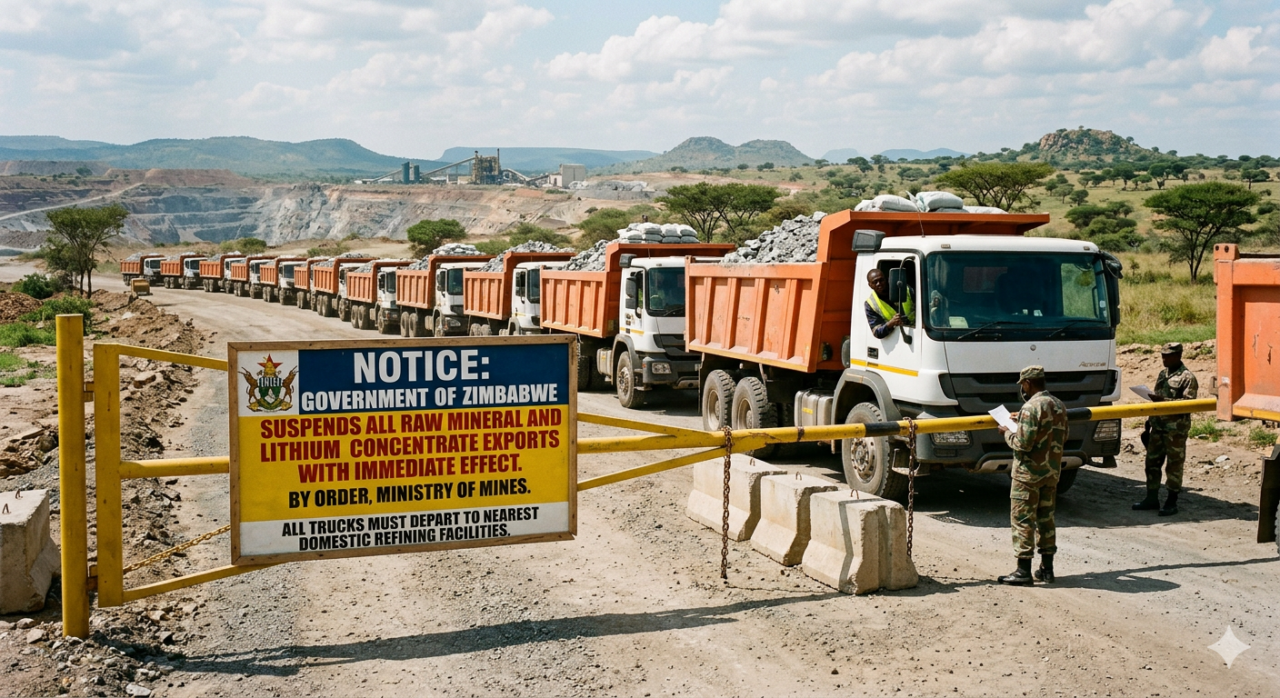
The Ministry of Mines and Mining Development has announced an immediate and indefinite suspension of all raw mineral and lithium concentrate exports, effective February 25, 2026, in a sweeping move designed to tighten regulatory control and accelerate domestic mineral processing.
Authorities say the decision is aimed at curbing “malpractices and leakages” in the mining sector while forcing companies to add value to minerals locally before export.
The directive applies to:
-
All raw mineral exports
-
All lithium concentrates
-
Shipments already in transit at the time of the announcement
Border authorities and customs officials have reportedly been instructed to enforce the order immediately.
The move fast-tracks an earlier government plan to phase out lithium concentrate exports by January 2027, effectively bringing the deadline forward by nearly a year.
Going forward, export authorizations will only be granted to companies that:
-
Hold valid mining titles
-
Operate approved local processing or beneficiation facilities
The government says this condition is non-negotiable and forms part of a broader restructuring of Zimbabwe’s mineral export regime.
Exports of lithium sulphate—an intermediate processed product—are not affected by the new policy. This exemption is seen as an incentive for companies that have already invested in partial value-added facilities within the country.
Zimbabwe’s position as Africa’s largest lithium producer means the announcement reverberated across global commodity markets.
Following the suspension:
-
Lithium carbonate prices surged 5.4% on the Guangzhou Futures Exchange
-
Shares of major lithium producers recorded gains in Asian and European markets
Analysts say the reaction underscores Zimbabwe’s growing influence within global electric vehicle (EV) and battery supply chains.
Zimbabwe is seeking to transition from a raw material exporter to a producer of higher-value refined lithium products. By mandating in-country beneficiation, the government aims to:
-
Create skilled industrial jobs
-
Boost tax revenue and foreign exchange earnings
-
Strengthen downstream manufacturing capacity
The new policy places increased pressure on foreign mining firms—particularly Chinese investors such as:
-
Zhejiang Huayou Cobalt
-
Sinomine Resource Group
These companies have invested billions of dollars in Zimbabwe’s lithium mines. The suspension now forces them to accelerate refinery construction and expand processing infrastructure inside the country if they wish to continue exporting.
Officials describe the move as part of a broader strategy of “resource nationalism,” ensuring that Zimbabwe maintains greater control over its mineral wealth rather than exporting low-value concentrates for refining abroad.
Zimbabwe holds Africa’s largest lithium reserves, positioning it as a key player in the global shift toward renewable energy and electric mobility.
With demand for lithium driven by EV battery production in China, Europe, and North America, Zimbabwe’s export policy now compels international supply chains to integrate more deeply with its domestic economy.
Analysts suggest that while short-term disruptions are likely, the long-term objective is to establish Zimbabwe as a regional lithium processing hub rather than merely a source of raw ore.
Industry observers will be watching closely to see:
-
How quickly mining firms scale up local refining capacity
-
Whether legal challenges or diplomatic negotiations arise
-
How global lithium markets adjust to tighter export controls
The suspension marks one of the most assertive economic policy shifts in Zimbabwe’s mining sector in recent years—one that could redefine the country’s role in the global energy transition.
Source: Omanghana