Omanghana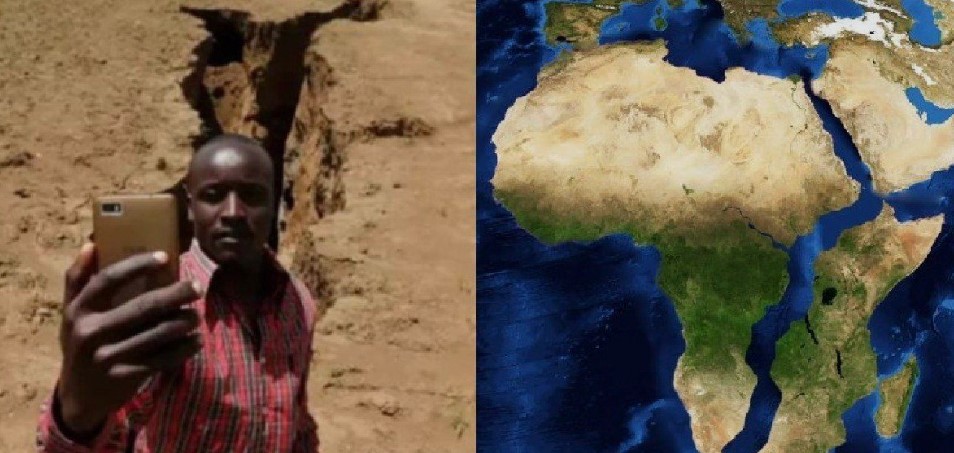
photo by Learn Geology
A remarkable geological process unfolding beneath East Africa is gradually reshaping the continent and could eventually lead to the formation of Earth’s sixth ocean, according to scientists studying the region’s tectonic activity.
The phenomenon is taking place along the East African Rift System, a vast network of faults and fractures stretching thousands of kilometers across the continent. Although dramatic images and viral social media posts often portray the development as an imminent catastrophe, geologists emphasize that the process is occurring at an extremely slow pace of approximately 5 to 7 millimeters per year.
Experts estimate that it could take between 5 million and 10 million years before seawater fully inundates the rift and separates part of East Africa from the rest of the continent.
The ongoing continental breakup is driven by the movement of three major tectonic plates: the Nubian Plate, the Somali Plate, and the Arabian Plate. As these plates slowly drift apart, the Earth’s crust is stretched and progressively thinned.
Over time, scientists say, the crust could become so thin that magma from deep within the Earth rises to the surface, creating a mid-ocean ridge similar to those found beneath existing oceans. This process would ultimately pave the way for the formation of a new ocean basin.
Recent research has provided fresh insights into how advanced the geological transformation may already be. A study published in the scientific journal Nature Communications by researchers from Columbia University’s Lamont-Doherty Earth Observatory examined the Turkana Rift Zone in Kenya and found evidence that the continental crust in the region has thinned significantly.
According to the study, portions of the crust have been reduced to approximately 13 kilometers in thickness—far thinner than the average continental crust, which is typically around 35 kilometers thick. Researchers identified this as a critical stage in the rifting process, often referred to as the “necking” phase, where the crust begins to narrow before eventual separation.
The scientists also discovered that ancient episodes of tectonic activity had already weakened the underlying rock formations, making the region more susceptible to the current phase of continental stretching. This pre-existing structural weakness may be helping to accelerate the geological processes that could eventually lead to the continent’s separation.
Beyond its geological significance, the rift system has also played an important role in human history. Researchers note that the tectonic activity helped create unique environmental conditions that contributed to the preservation of some of the world’s most important early hominin fossils, offering crucial insights into human evolution.
If the rifting process continues to its ultimate conclusion millions of years from now, it could dramatically alter the geography of Africa. Scientists predict that low-lying regions such as Ethiopia’s Afar Depression may eventually fall below sea level, allowing waters from the Red Sea and the Gulf of Aden to flood into the expanding rift valley.
The transformation could ultimately result in the separation of the Horn of Africa from the rest of the continent. Regions that are currently part of Somalia, eastern Ethiopia, Kenya, and Tanzania could gradually drift away to form a large island landmass in the Indian Ocean.
Such a shift would also create entirely new coastlines across parts of East and Central Africa. Countries that are currently landlocked could potentially gain access to the ocean, fundamentally changing regional trade routes, transportation networks, and economic opportunities.
While the prospect of a new ocean capturing part of Africa may sound extraordinary, scientists stress that the process is unfolding on a geological timescale far beyond human lifetimes. Nevertheless, the East African Rift System remains one of the most fascinating examples of Earth’s dynamic and ever-changing nature, offering a rare glimpse into how continents evolve and oceans are born.
Source: Omanghana