Omanghana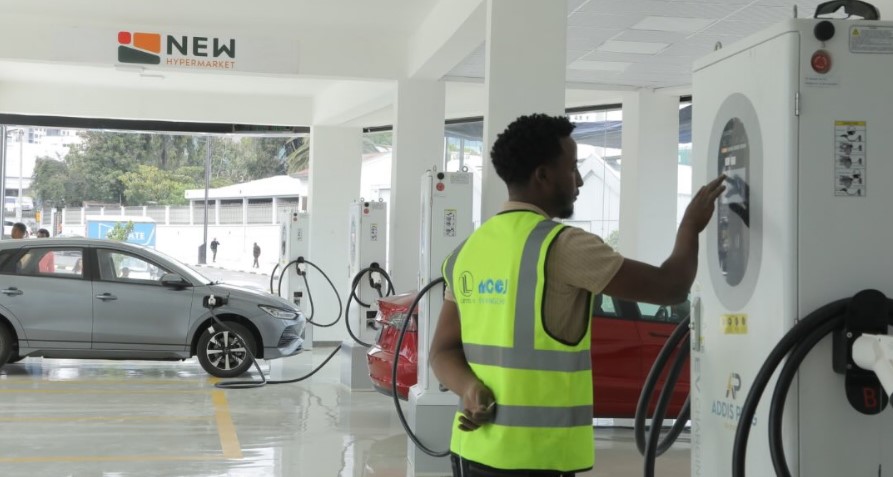
Ethiopia is accelerating its transition to green mobility with an ambitious expansion of its electric vehicle (EV) charging infrastructure, reinforcing its position as one of the most aggressive adopters of clean transport policies globally. The push follows the country’s landmark 2024 ban on the importation of fossil-fuel-powered passenger cars, a bold policy that has rapidly reshaped its automotive landscape. As of April 2026, Ethiopia now has more than 140,000 electric vehicles on its roads, the majority concentrated in the capital, Addis Ababa.
To support this rapid growth, the state-owned Ethiopian Electric Utility, alongside other government institutions, has launched a nationwide infrastructure program aimed at building a robust and reliable EV charging network. Central to this effort is a long-term plan to deploy over 2,300 charging stations across the country within the next decade, laying the foundation for widespread adoption of electric mobility.
The rollout is being implemented in two phases. The first phase, currently underway, focuses on pilot deployment and urban readiness. It involves the construction of 40 initial charging stations backed by an investment of approximately $10 million. Of these, 32 stations are nearing completion in Addis Ababa, while the remaining eight are being developed in surrounding areas to extend coverage beyond the capital. This phase is designed to test infrastructure performance, refine operational models, and address early-stage challenges.
The second phase will expand the network to key regional cities, including Bishoftu, Mojo, Adama, Shashemene, and Hawassa. This expansion is critical for enabling long-distance travel and ensuring that EV adoption is not confined to urban centers. By connecting major economic and transport corridors, Ethiopia aims to create a seamless national charging network that supports both private and commercial electric vehicles.
Telecommunications giant Ethio Telecom is also playing a growing role in this transformation. In April 2026, the company commissioned its fourth super-fast charging hub in Adama, marking its first expansion outside Addis Ababa. This development highlights the increasing involvement of multiple sectors in building the country’s EV ecosystem and underscores the strategic importance of public-private collaboration.
The new generation of charging stations is being designed with advanced capabilities, including the ability to serve up to 24 vehicles simultaneously. Equipped with modern battery management systems, these facilities are intended to ensure safe, efficient, and durable charging, addressing concerns around battery performance and infrastructure reliability.
A key driver behind Ethiopia’s EV strategy is energy sovereignty. By leveraging abundant and low-cost renewable energy—particularly from large-scale hydropower projects like the Grand Ethiopian Renaissance Dam—the country aims to significantly reduce its dependence on imported fossil fuels. Officials estimate that this transition could save Ethiopia more than $1.4 billion annually in fuel import costs, providing a strong economic incentive alongside environmental benefits.
To further encourage adoption, the EEU has introduced competitive electricity tariffs ranging from 14 to 18 Ethiopian birr (approximately $0.09 to $0.12) per kilowatt-hour. These rates make electric vehicles substantially cheaper to operate than conventional internal combustion engine vehicles, offering both cost savings for consumers and a compelling case for businesses to transition their fleets.
The government has also introduced regulatory measures to accelerate infrastructure development. Under Directive No. 1034/2024, vehicle importers and assemblers are now required to establish charging stations as a condition for entering the market. Additionally, new mandates are being implemented for hotels, real estate developments, and fuel stations to include EV charging facilities, ensuring that infrastructure keeps pace with vehicle adoption.
Despite these impressive strides, significant challenges remain. The current number of charging stations falls far short of demand, with estimates suggesting that Addis Ababa alone requires at least 1,176 stations to adequately serve its growing EV population. On a broader scale, nearly half of Ethiopia’s population still lacks reliable access to electricity, highlighting a fundamental infrastructure gap that could limit nationwide adoption if not addressed.
Ethiopia’s rapid embrace of electric mobility represents a bold and forward-looking approach to sustainable development. By combining policy reform, infrastructure investment, and renewable energy utilization, the country is setting a powerful example for others. However, the long-term success of this transition will depend on its ability to close infrastructure gaps, expand energy access, and ensure that the benefits of green mobility are shared across all regions.
Source: Omanghana