Omanghana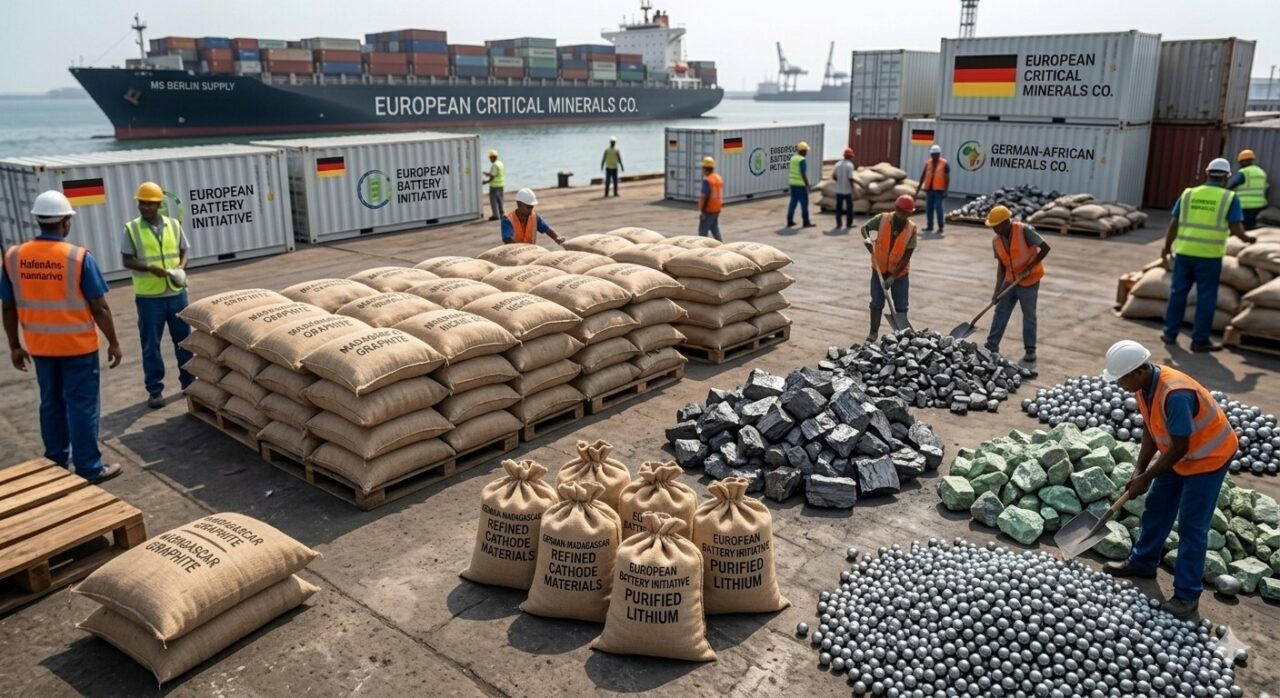
Germany has launched an official assessment of Madagascar’s rapidly expanding mining sector as Europe intensifies efforts to reduce dependence on China for critical electric vehicle battery materials.
Geoscientists from Federal Institute for Geosciences and Natural Resources recently completed an independent evaluation of Madagascar’s mining infrastructure, identifying the island nation as a potential strategic supplier of critical minerals for Europe’s energy transition and electric mobility ambitions.
At the center of Germany’s growing interest is natural graphite, a mineral officially classified by the European Union as a strategic raw material. Graphite is a core component used in the production of lithium-ion battery anodes, making it essential for electric vehicle manufacturing and energy storage technologies.
Madagascar has rapidly emerged as a major global graphite supplier, officially overtaking Mozambique to become Africa’s largest graphite producer. The country produced approximately 85,000 tonnes of graphite in 2024, followed by 80,000 tonnes in 2025, strengthening its importance in the global battery minerals market.
German state geologists focused much of their assessment on the Molo Mine, a major graphite operation owned by NextSource Materials. The mine is widely regarded as home to some of the world’s largest and highest-quality graphite reserves, positioning it as a critical asset in future EV supply chains.
Europe’s growing urgency stems from China’s overwhelming dominance across both the mining and processing stages of lithium-ion battery minerals. Chinese companies currently control significant portions of the global graphite refining and battery materials market, creating supply chain risks for European automakers and manufacturers transitioning toward electric mobility.
Germany’s automotive sector, one of the largest industrial pillars in Europe, remains heavily dependent on imported raw materials to support the country’s EV transition strategy. As a result, Berlin has increasingly prioritized long-term supply agreements and overseas mining partnerships to strengthen resource security.
Existing industrial links between Germany and Madagascar are already taking shape. Thyssenkrupp currently holds a 10-year sales agreement with the Molo mine, securing up to 35,000 tonnes of graphite annually for European manufacturing operations. The deal is viewed as a major step toward stabilizing critical mineral supplies for Germany’s industrial base.
The latest assessment also aligns with Germany’s broader financial strategy to de-risk critical mineral investments. Berlin operates a dedicated €1 billion raw materials fund designed to provide minority equity investments in qualifying upstream mining projects worldwide.
In addition, Germany is participating in a wider €2.5 billion European critical minerals investment alliance alongside France and Italy. The initiative aims to counter China’s expanding influence in Africa’s mineral sector while strengthening Europe’s long-term access to strategic resources required for the clean energy transition.
Analysts say Madagascar’s graphite reserves could play a pivotal role in reshaping future global battery supply chains as Western nations accelerate efforts to diversify sourcing away from China and secure stable mineral supplies for the rapidly growing EV market.
Source: Omanghana