Omanghana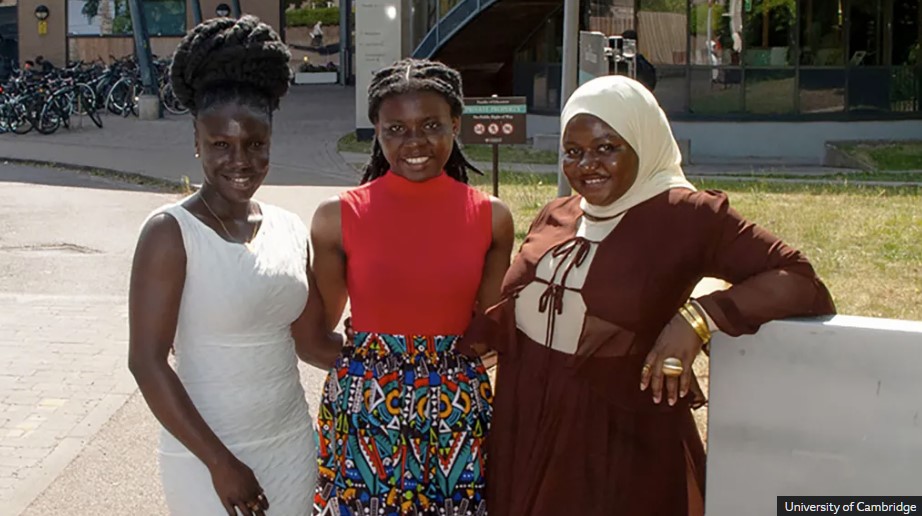
The growing presence and achievements of Ghanaian women at the University of Cambridge are reshaping long-standing narratives in global academia, reflecting a broader shift in access, representation, and intellectual leadership.
By overcoming structural barriers tied to geography, finance, and historical underrepresentation, these scholars are emerging as influential voices across disciplines ranging from artificial intelligence to sustainable development and public policy.
Their success highlights how targeted funding and academic merit are combining to open doors previously closed to many students from the Global South.
Breaking Through Long-Standing Academic Barriers
Admission into the University of Cambridge remains one of the most competitive academic pathways in the world, particularly for international postgraduate applicants, where acceptance rates are often below 15%.
For many Ghanaian women, the journey to Cambridge involves navigating multiple layers of structural challenge:
- Financial constraints: Annual tuition and living costs for international students can range between £45,000 and £65,000
- Representation gaps: Black African women remain significantly underrepresented in elite institutions such as Cambridge and other Oxbridge universities, especially in STEM disciplines
- Field transformation: Increasingly, scholars are moving beyond traditional academic tracks into high-impact areas such as renewable energy engineering, health economics, data science, and artificial intelligence
This shift reflects a broader evolution in how African scholars are engaging with global knowledge production, particularly in fields linked to development and innovation.
Scholarship Pathways Driving Academic Access
A key factor behind the rise in Ghanaian women at Cambridge is the expansion of highly competitive international scholarship programs designed to support talented students from underrepresented regions.
Mastercard Foundation Scholars Program
One of the most significant pathways, the Mastercard Foundation Scholars Program provides full financial support, including tuition, travel, and living expenses.
The program is designed to support academically strong students who demonstrate leadership potential and a commitment to contributing to development efforts upon returning to their home countries.
Gates Cambridge Scholarship
Funded by the Bill & Melinda Gates Foundation, the Gates Cambridge Scholarship is one of the most prestigious postgraduate awards in the world.
It supports students who demonstrate exceptional academic excellence alongside a strong vision for leadership and societal impact.
Commonwealth Scholarships
The Commonwealth Scholarship framework continues to serve as a long-standing academic bridge for high-performing students from member countries, including Ghana, enabling access to advanced research environments in the United Kingdom.
These funding pipelines collectively reduce financial barriers and expand access to world-class academic training.
From Cambridge to Local Impact
A defining feature of many Ghanaian women trained at Cambridge is their commitment to applying knowledge directly to challenges in West Africa rather than remaining solely in global academic or corporate environments.
Their work spans multiple sectors:
Healthcare Innovation
Some scholars are focusing on developing low-cost diagnostic tools and public health solutions aimed at addressing maternal mortality and cervical cancer in underserved rural communities.
These innovations are often designed with scalability and affordability in mind, ensuring they can be deployed in resource-constrained health systems.
Urban Planning and Climate Resilience
Graduates from fields such as land economy and urban planning are contributing to policy development efforts aimed at addressing challenges like flooding in Accra, land-use inefficiencies, and rapid urban expansion.
Their research is increasingly informing discussions around sustainable infrastructure and environmental resilience.
Artificial Intelligence and Language Inclusion
In the technology space, Ghanaian women researchers are working on artificial intelligence systems that prioritize linguistic inclusion, particularly for indigenous African languages.
These efforts aim to ensure that emerging digital technologies are accessible beyond English-speaking populations, helping bridge the global digital divide.
Redefining African Academic Leadership
The presence of Ghanaian women at Cambridge represents more than individual achievement; it reflects a broader transformation in global knowledge systems.
By entering and excelling in one of the world’s most prestigious academic institutions, these scholars are challenging traditional assumptions about who leads innovation and where intellectual authority resides.
Their work demonstrates that when financial barriers are reduced and opportunities are expanded, talent from across Africa not only participates in elite academia—it actively shapes it.
As their influence continues to grow, Ghanaian women at Cambridge are helping redefine the future of global scholarship through research that connects world-class education with real-world impact.
Source: Omanghana