Omanghana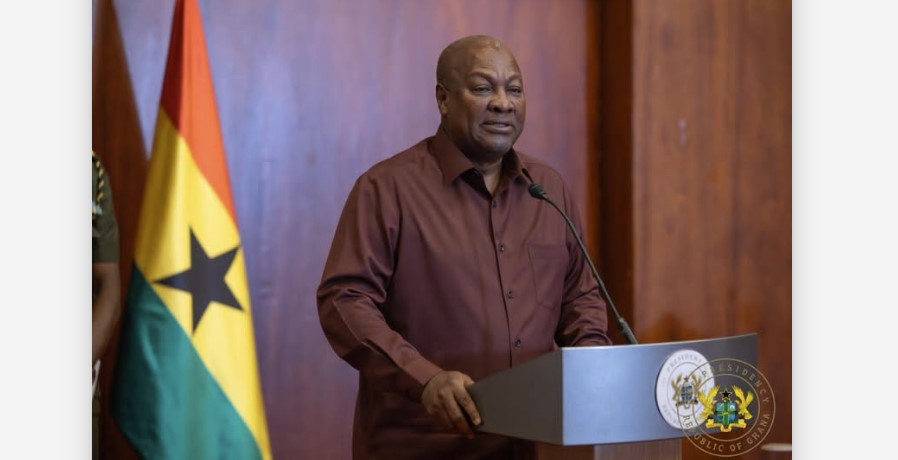
Ghana’s President John Dramani Mahama is spearheading an ambitious campaign to reshape global discourse on reparatory justice, moving it beyond symbolic acknowledgements toward a legally binding international framework for restitution and compensation.
In his role as the African Union (AU) Champion for Reparations, President Mahama has positioned Ghana at the center of renewed diplomatic efforts to address the enduring legacy of the transatlantic slave trade and colonialism through structured global mechanisms.
From Symbolism to Legal Obligation
A key pillar of President Mahama’s strategy is the push to redefine reparatory justice as a matter of international legal responsibility rather than voluntary goodwill or development assistance.
This approach gained significant momentum in March 2026, when the United Nations General Assembly adopted Resolution A/RES/80/250, a landmark measure spearheaded by Ghana on behalf of the African Union and supported by 123 member states.
For the first time in UN history, the resolution explicitly characterized the trafficking and enslavement of Africans as the “gravest crime against humanity.”
By securing this designation, Mahama and his allies aim to establish a legal and moral foundation for future restitution claims, framing reparations as a historical obligation grounded in international law.
Launch of New Global Implementation Frameworks
At the High-Level Consultative Conference on Reparatory Justice in Accra, President Mahama unveiled a series of institutional mechanisms designed to translate diplomatic commitments into practical action.
These include three newly established global panels:
Global Advisory Panel on Reparatory Justice
Composed of heads of state, diplomats, and eminent public figures, this panel is tasked with guiding high-level political engagement and facilitating dialogue between African states, diaspora nations, and former colonial powers.
Global Legal Panel on Reparatory Justice
This body will focus on developing legal strategies and frameworks to support reparative claims through international courts and arbitration mechanisms, aiming to formalize pathways for restitution.
Expert Panel on the Restitution of Cultural Artefacts
Dedicated to the recovery of African cultural heritage, this panel will coordinate efforts to secure the return of artifacts, manuscripts, and sacred objects currently held in institutions outside the continent.
Navigating Global Political Divisions
President Mahama’s initiative comes amid differing international responses to the UN resolution. While the measure received broad support, several Western nations either opposed or abstained from the vote.
Mahama has argued that global progress on historical justice requires broader participation rather than exclusion, emphasizing that meaningful reconciliation depends on inclusive engagement with all stakeholders.
His administration continues to frame reparatory justice as a shared global responsibility rather than a politically divisive issue.
Strengthening AU–CARICOM Cooperation
A central feature of Mahama’s approach is the deepening partnership between the African Union (AU) and the Caribbean Community (CARICOM).
This alliance is designed to unify African nations and the African diaspora in the Caribbean, creating a coordinated diplomatic bloc capable of advancing a common position on reparations and historical accountability in international forums.
Expanding the Definition of Reparatory Justice
Beyond financial compensation, President Mahama’s framework emphasizes broader structural reforms aimed at addressing the long-term consequences of colonial exploitation.
Key areas of focus include:
- Structural economic reform: addressing global trade imbalances and systemic inequalities rooted in colonial history
- Historical accountability: promoting truth-telling initiatives, institutional recognition, and educational reform
- Cultural restitution: returning looted heritage and restoring ownership of African cultural assets
These priorities are intended to address not only historical injustices but also their continued economic and social impact in the present day.
The Decade of Reparations
The initiative is anchored in the African Union’s Agenda 2063 and the Decade of Reparations (2026–2036), which seeks to ensure sustained global engagement on issues of historical justice over the next ten years.
Under this framework, reparatory justice is expected to remain a permanent feature of international policy discussions, shaping diplomatic, economic, and cultural relations between Africa, the diaspora, and the wider global community.
Toward a New Global Consensus
President Mahama’s campaign represents an effort to build a new international consensus on historical accountability—one that integrates legal structures, diplomatic cooperation, and institutional reforms.
As global negotiations continue, the Accra-based initiative signals a renewed push by African leadership to place reparatory justice at the center of 21st-century international relations.
Source: Omanghana