Omanghana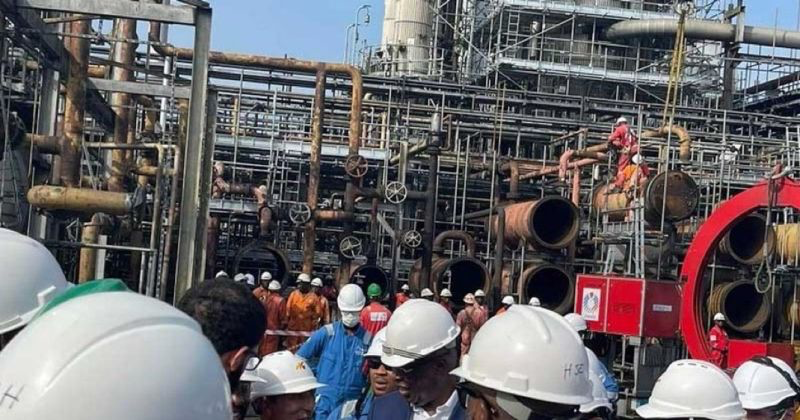
Nigerian National Petroleum Company Limited has abandoned its long-running state-funded refinery repair strategy after spending more than ₦11 trillion (about $25 billion) on unsuccessful overhauls since 2010.
The move comes as Nigeria continues to battle decades of refinery dysfunction, poor maintenance, and operational inefficiencies across its major state-owned facilities.
NNPC Group CEO Bayo Ojulari has now signed a major Memorandum of Understanding with two Chinese firms to rehabilitate, operate, and maintain key Nigerian refineries under a new investment structure.
The agreement marks a shift away from the traditional government-funded “Turnaround Maintenance” model toward a Technical Equity Partnership arrangement, requiring foreign partners to invest their own capital into the projects.
The partnership focuses on reviving the Port Harcourt refinery, which has a capacity of 210,000 barrels per day, and the Warri refinery, which can process 125,000 barrels per day.
The Chinese companies involved are Sanjiang Chemical Company Limited and Xinganchen (Fuzhou) Industrial Park Operation and Management Co. Ltd..
According to NNPC, the deal goes beyond fuel refining and aims to transform the facilities into broader industrial and petrochemical hubs supported by gas-based industries.
However, the agreement has already attracted criticism from industry experts and business groups.
Analysts have questioned whether the Chinese firms possess sufficient experience in large-scale refinery rehabilitation. Critics note that Sanjiang Chemical mainly specializes in petrochemical manufacturing, while Xinganchen focuses on industrial park infrastructure rather than crude oil refining operations.
Organizations including the Nigeria Employers’ Consultative Association and Petroleum and Natural Gas Senior Staff Association of Nigeria have also raised concerns about transparency and governance surrounding the deal.
Some stakeholders argue that after years of failed rehabilitation efforts and billions of dollars in spending, the Nigerian government should fully privatize the refineries instead of maintaining state ownership stakes.
Skepticism has also been fueled by previous failed restart attempts. The Port Harcourt refinery briefly resumed operations in late 2024 before shutting down again by mid-2025 due to persistent technical problems.
The latest push to revive Nigeria’s refineries comes at a time when the country’s fuel market has already undergone major changes following the rise of the privately owned Dangote Refinery.
The 650,000-barrel-per-day Dangote facility has significantly reduced Nigeria’s dependence on imported fuel and helped transform the country into a net petrol exporter. National daily fuel imports reportedly dropped from more than 42 million liters in late 2025 to around 3 million liters in early 2026.
Despite that progress, experts warn that domestic crude supply shortages remain a major challenge, raising questions about whether Nigeria’s state-owned refineries will have enough feedstock to operate efficiently even if rehabilitation efforts succeed.
Source: Omanghana