Omanghana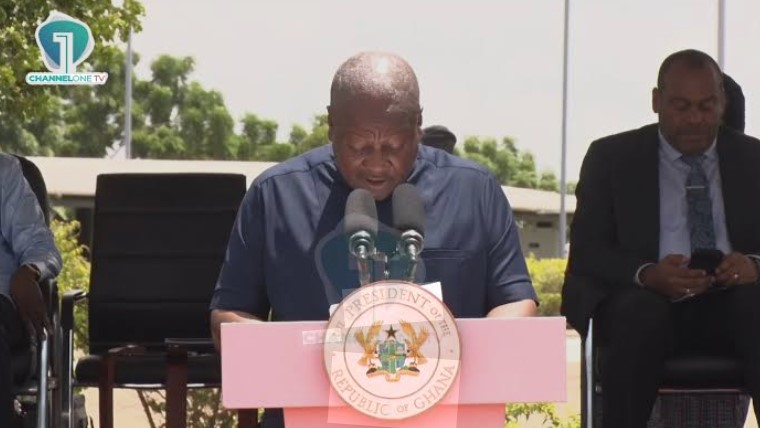
President John Dramani Mahama has strongly criticized traditional teaching methods in Ghana, arguing that mathematics has historically been taught through fear and punishment rather than understanding and innovation.
Speaking at the launch of the newly rebranded Ghana Science and Mathematics Quiz (GSMQ) at the National Theatre of Ghana in Accra, the President called for urgent reforms to Ghana’s educational curriculum to encourage critical thinking, creativity, and practical problem-solving skills.
Reflecting on his own school experience, President Mahama lamented the culture of fear that surrounded mathematics education for decades. According to him, many students learned under the constant threat of corporal punishment rather than through encouragement and conceptual understanding.
“We solved problems under fear of caning,” the President stated, explaining that the approach created anxiety toward mathematics for generations of learners.
He stressed that such methods discouraged curiosity and confidence, leaving many students intimidated by science and mathematics subjects long after leaving school.
President Mahama also criticized Ghana’s long-standing “chew, pour, pass, and forget” educational system, describing it as a major obstacle to innovation and national development.
According to him, the current system places excessive emphasis on memorization instead of teaching students how to apply mathematical concepts to practical, real-world challenges.
He argued that education must move beyond examination-based performance and focus more on analytical thinking, experimentation, and creativity.
The President warned that Ghana cannot successfully build a digitized and industrialized economy if students continue to fear science, technology, engineering, and mathematics (STEM) subjects.
He emphasized that modern economies are increasingly driven by technology, artificial intelligence, robotics, and innovation, making STEM education essential for Ghana’s future competitiveness.
President Mahama therefore directed the Ministry of Education to prioritize reforms that make science and mathematics more engaging, collaborative, and student-friendly.
As part of the proposed reforms, the President instructed the Ministry of Education to retrain teachers nationwide to adopt trauma-free and encouraging teaching methods.
He urged educators to move away from intimidation-based instruction and instead create classroom environments where students feel safe to ask questions, experiment, and learn from mistakes.
According to him, teachers must become facilitators of innovation rather than enforcers of fear.
The event also marked the official transition of the iconic National Science and Maths Quiz (NSMQ) into the newly renamed Ghana Science and Mathematics Quiz (GSMQ).
The revamped competition is expected to operate under an expanded government-backed framework aimed at improving inclusiveness and widening access to quality STEM opportunities across the country.
Under the new structure, the competition will include dedicated and equitable participation tracks for less-endowed schools and private institutions.
The move is designed to ensure that rural and underserved schools are not overshadowed by traditionally dominant elite schools.
The GSMQ will now broaden its scope beyond traditional science and mathematics topics to include emerging technological disciplines such as:
- Artificial Intelligence (AI)
- Robotics
- Coding
- Digital innovation
The expansion is intended to prepare Ghanaian students for the rapidly evolving global technology landscape.
The presidency also announced enhanced state sponsorship for the competition.
As part of the initiative, winning schools will receive modern science laboratory equipment and improved learning resources to strengthen STEM education nationwide.
President Mahama noted that investing in science and technology education is critical to Ghana’s long-term economic transformation and industrial growth.
Source: Omanghana