Omanghana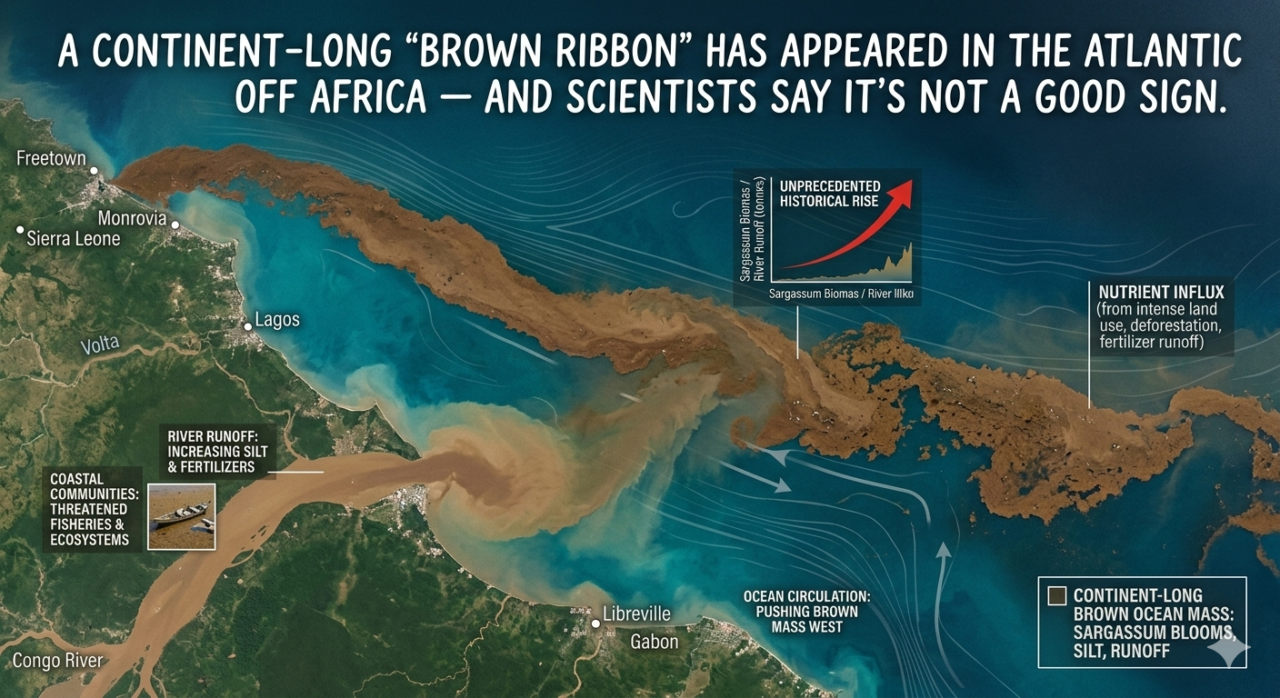
A massive bloom of floating seaweed stretching across the Atlantic Ocean—often described as a giant “brown ribbon”—has become one of the most striking environmental phenomena of the decade.
Officially known as the Great Atlantic Sargassum Belt, the formation spans approximately 8,850 kilometers (5,500 miles) from the coast of West Africa to the Gulf of Mexico. It is now so vast that it is clearly visible from space, raising growing alarm among scientists, coastal communities, and climate experts.
What Is the Great Atlantic Sargassum Belt?
Sargassum is a naturally occurring floating seaweed that plays a valuable ecological role in the open ocean. It provides habitat for fish, sea turtles, crabs, and seabirds, forming a unique ecosystem on the water’s surface.
However, when it accumulates in extraordinary quantities and drifts toward shorelines, it transforms from a beneficial marine habitat into an environmental crisis.
The bloom reached unprecedented levels in May 2025, with scientists estimating its weight at between 37.5 and 38 million tonnes.
To put that into perspective:
-
It is roughly double the width of the continental United States
-
It represents the largest Sargassum accumulation ever recorded
-
Its growth has accelerated compared to pre-2011 baselines, when such transatlantic belts were rare
Researchers warn that the expansion shows no consistent signs of stabilizing.
While Sargassum is harmless and even beneficial offshore, it becomes destructive when it piles up on beaches and near coral ecosystems.
Smothering Marine Life
When thick mats wash ashore or settle in shallow waters, they:
-
Block sunlight from reaching coral reefs and seagrass beds
-
Reduce oxygen levels in coastal waters
-
Suffocate marine organisms
Coral reefs, already under stress from warming oceans, are particularly vulnerable to prolonged Sargassum coverage.
Health and Economic Consequences
As Sargassum decomposes on beaches, it releases hydrogen sulfide gas, which smells like rotten eggs and can cause:
-
Eye and throat irritation
-
Respiratory problems
-
Headaches and nausea
In heavily affected areas across the Caribbean, Central America, and parts of West Africa, residents have reported worsening air quality during peak accumulation periods.
The economic toll is significant:
-
Beach closures and reduced tourism revenue
-
Disruptions to fishing activities
-
Millions of dollars are spent annually on cleanup operations
In some Caribbean nations, Sargassum management has become a permanent budget line item.
A Warning Sign of Climate Stress
Scientists attribute the rapid and persistent expansion of the Great Atlantic Sargassum Belt to several interconnected factors:
Rising Ocean Temperatures
Warmer waters create favorable growth conditions for Sargassum.
Increased agricultural runoff and deforestation—particularly linked to river systems such as the Amazon and Congo—are believed to deliver higher levels of nitrogen and phosphorus into the Atlantic, effectively fertilizing the bloom.
Changing Ocean Currents
Alterations in wind and current patterns may be concentrating and sustaining the belt across vast distances.
Researchers describe the phenomenon as a potential climatic warning signal, reflecting the combined impacts of global warming and land-use change.
Emerging studies suggest that when massive Sargassum mats decay in hot tropical conditions, they may release methane, a potent greenhouse gas.
If confirmed at large scale, this could create a feedback loop:
-
Rising temperatures increase Sargassum growth
-
Decomposition releases greenhouse gases
-
Additional warming further fuels bloom expansion
Scientists caution that more research is needed, but the possibility adds urgency to understanding and mitigating the trend.
Monitoring systems now track the belt’s movement across the Atlantic, particularly as it approaches vulnerable coastlines in the Caribbean, the Gulf of Mexico, and West Africa.
While Sargassum remains a natural ocean component, its unprecedented scale and recurring coastal impact suggest that the Great Atlantic Sargassum Belt is no longer just a marine curiosity—it is a visible symbol of accelerating environmental change.
As researchers continue to study its trajectory and causes, policymakers face mounting pressure to address both local mitigation efforts and the broader climate and pollution drivers behind its growth.
Source: Omanghana