Omanghana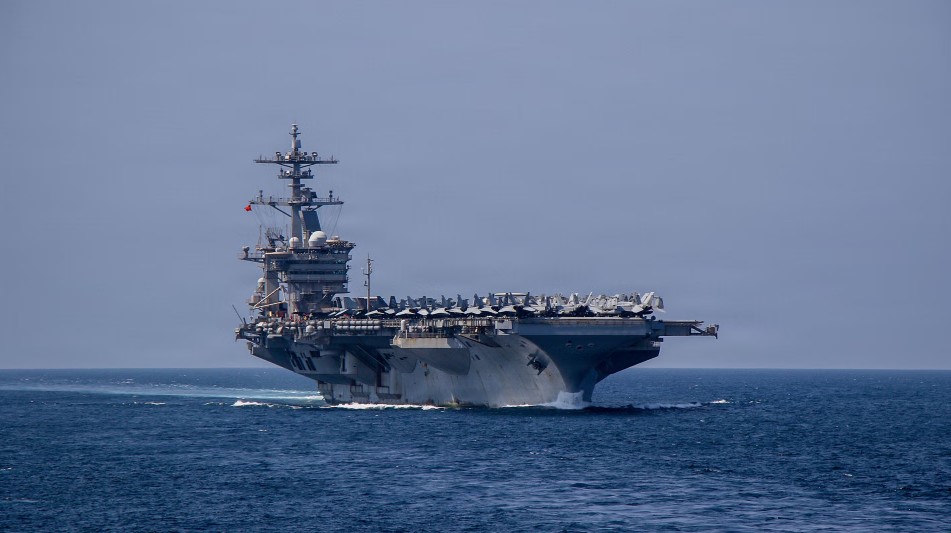
The United States Navy has launched a high-stakes dual-track operation in the Strait of Hormuz, combining a targeted naval blockade of Iranian ports with active mine-clearing efforts aimed at restoring safe passage for global shipping. The operation, which began at 10:00 AM ET on Monday, April 13, 2026, marks a significant escalation in maritime security measures following the collapse of diplomatic talks in Islamabad and reflects growing tensions in one of the world’s most strategically critical waterways.
The blockade, ordered by Donald Trump, is narrowly focused on vessels entering or leaving Iranian ports, with U.S. officials emphasizing that freedom of navigation for ships transiting to non-Iranian destinations—such as ports in Iraq, Kuwait, and the United Arab Emirates—will not be impeded. This targeted approach is intended to apply pressure on Iran while minimizing disruption to broader international trade routes that depend on the strait.
According to Brad Cooper, commander of United States Central Command, the blockade was fully operational within hours of implementation. In the first 36 hours alone, at least nine vessels reportedly complied with U.S. directives to either turn back or return to Iranian ports, signaling early enforcement success. The scale of the operation is underscored by the deployment of approximately 27 U.S. naval vessels to the region, including major assets such as the aircraft carriers USS Gerald R. Ford and USS Abraham Lincoln, with a third carrier strike group reportedly en route.
Parallel to the blockade, the U.S. Navy has initiated efforts to clear sea mines believed to have been laid by Iran’s Islamic Revolutionary Guard Corps in the strait. These operations began on April 11 as part of a broader effort to “set conditions” for restoring safe maritime transit. The first U.S. warships to navigate the strait since the onset of hostilities in late February were the guided-missile destroyers USS Frank E. Peterson (DDG-121) and USS Michael Murphy (DDG-112), both Arleigh Burke-class vessels.
Although these destroyers are not specifically designed for minesweeping, they are being used as operational hubs for advanced unmanned systems. The Navy is deploying unmanned undersea vehicles (UUVs) and underwater drones capable of detecting and neutralizing explosive devices, allowing for safer and more efficient mine-clearing operations without exposing crews to unnecessary risk. The ultimate objective is to establish a secure maritime corridor—a “new passage”—that enables international commerce to continue while bypassing areas considered under the influence of Iranian forces.
The developments in the Strait of Hormuz are already having far-reaching economic implications. The waterway, which handles roughly 20 percent of the world’s oil supply, is a critical artery for global energy markets. The heightened risk of disruption has pushed crude oil prices above $100 per barrel, adding pressure to an already volatile global economic environment.
Tensions remain high, with Iran warning that any military vessel approaching the strait could be interpreted as a violation of the fragile two-week ceasefire currently in place, which is set to expire on April 22. Iranian officials have signaled that such actions would provoke a “severe response,” raising concerns about the potential for further escalation.
The situation has also drawn sharp international reactions. China, which relies on the Strait of Hormuz for approximately 45 percent of its Gulf oil imports, has criticized the U.S. blockade as “dangerous and irresponsible,” highlighting the broader geopolitical stakes involved. As major global powers weigh in, the unfolding situation underscores the delicate balance between security operations and the need to maintain stability in global trade routes.
As the U.S. Navy continues its dual mission of enforcement and clearance, the Strait of Hormuz remains a focal point of global attention. The coming days will be critical in determining whether these measures succeed in stabilizing the region or contribute to further escalation in an already tense geopolitical landscape.
Source: Omanghana