Omanghana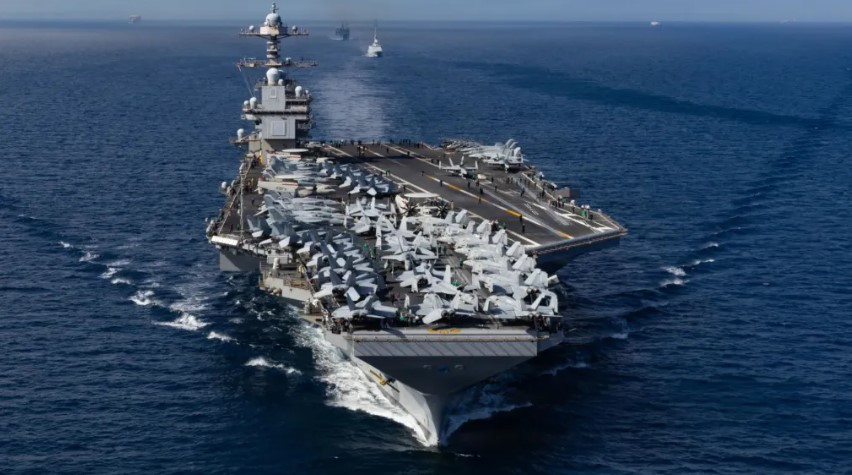
The United States Navy is preparing for a groundbreaking test that could transform its newest aircraft carriers into floating emergency power stations capable of supplying electricity to military bases and disaster zones ashore.
Acting Secretary of the Navy Hung Cao announced that later this year the nuclear-powered aircraft carrier USS Gerald R. Ford will attempt to send electricity generated by its onboard reactors directly into the land-based power grid at Naval Station Norfolk.
The historic demonstration will reverse the traditional energy flow used while carriers are docked. Instead of receiving electricity from shore facilities, the carrier will export power back to the naval base using its massive onboard energy capacity.
The test forms part of a wider Pentagon strategy aimed at strengthening energy resilience at critical military installations. Defense planners are increasingly concerned about the vulnerability of domestic bases to cyberattacks, severe weather events, natural disasters, and potential military strikes targeting civilian infrastructure.
At the center of the project is the enormous electrical surplus built into the Ford-class carrier design. The USS Gerald R. Ford is powered by two next-generation A1B nuclear reactors that generate roughly three times more electrical power than the older reactors used aboard Nimitz-class carriers. Officials say the ship’s propulsion system produces enough electricity to comfortably power a city of approximately 100,000 people.
Unlike previous aircraft carriers that relied on steam-powered launch systems, the Ford-class uses advanced Electromagnetic Aircraft Launch Systems (EMALS). Because EMALS operates through software-driven electrical technology rather than steam catapults, engineers designed the ship with extensive unused electrical reserves that can potentially be redirected for other purposes.
Military engineers, however, must overcome several major technical obstacles before the concept can become operational. Shipboard electrical systems function at different voltages and frequencies than traditional land-based grids, meaning the carrier’s output must be precisely synchronized before any connection can safely occur.
Specialized conversion hardware, protective relays, and advanced fault-isolation systems will also be required to regulate the transfer of electricity and prevent damage to local substations or military infrastructure during the power exchange.
The concept of using military vessels as emergency power generators is not entirely new. In 1929, the aircraft carrier USS Lexington famously supplied emergency electricity to the city of Tacoma, Washington, for nearly a month during a devastating drought-induced power crisis.
Another historic example came between 1968 and 1975 when the Sturgis, a converted World War II Liberty ship operated by the U.S. Army Corps of Engineers, used a 10-megawatt nuclear reactor to provide electricity to the Panama Canal Zone.
If the upcoming Norfolk demonstration succeeds, defense analysts say every Ford-class aircraft carrier could eventually serve as a mobile nuclear power station capable of supporting military operations, stabilizing critical infrastructure, or delivering large-scale humanitarian disaster relief anywhere in the world.
Source: Omanghana