Omanghana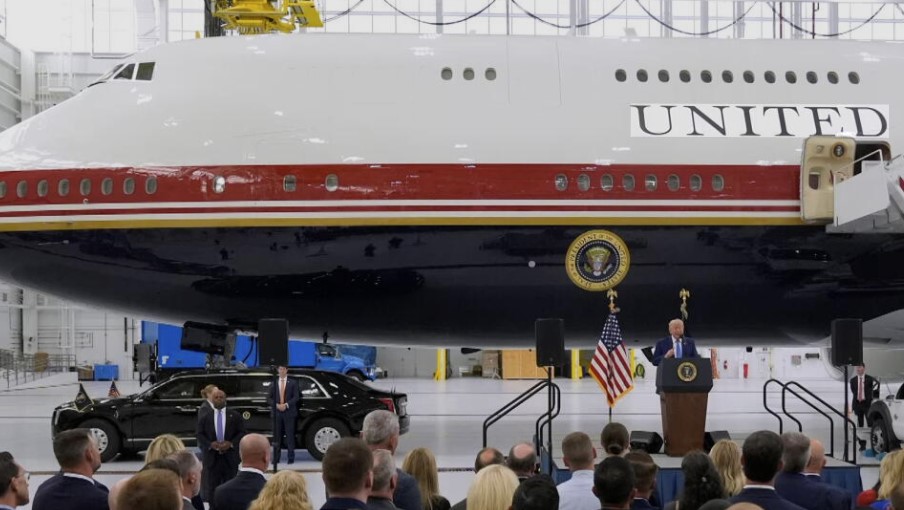
President Donald Trump used a high-profile appearance at Joint Base Andrews on June 19, 2026, to unveil a redesigned presidential aircraft and announce details of U.S. efforts to safeguard commercial oil shipments through the Strait of Hormuz.
The twin announcements touched on executive aviation, national security, and global energy markets, while also prompting debate over ethics, maritime security, and the long-term implications of recent U.S. actions in the Persian Gulf.
New Presidential Aircraft Introduced as Interim Air Force One
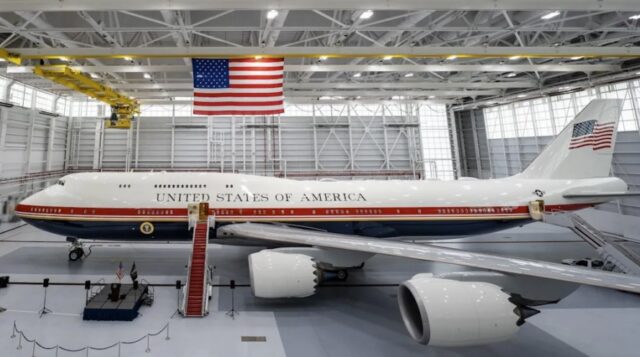
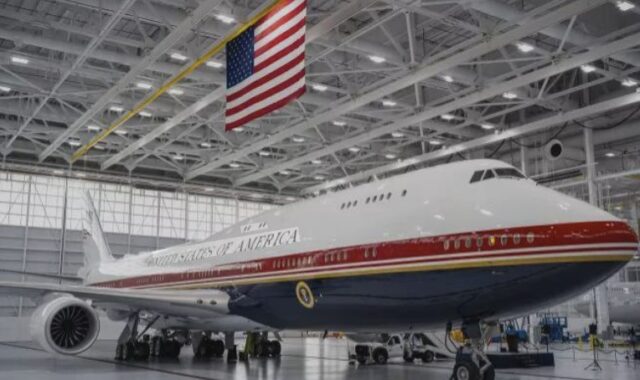
At the center of the event was the presentation of a Boeing 747-8 that will serve as an interim presidential aircraft.
According to the administration, the jet was previously owned by Qatar’s royal family and later accepted by the U.S. government. Officials said its existing interior configuration reduced the need for extensive modifications, allowing it to enter service more quickly while Boeing continues work on the delayed VC-25B replacement program.
The aircraft also debuts a new exterior design that departs from the traditional light-blue color scheme associated with presidential aircraft since the Kennedy administration. The updated livery features a dark blue lower fuselage, a white upper section, and a prominent red stripe.
The decision has generated political discussion in Washington, with some lawmakers questioning the acceptance of a foreign-origin aircraft and raising constitutional and ethical concerns about gifts from overseas governments.
Administration Reveals Details of Gulf Shipping Operations
During the address, Trump also described previously undisclosed U.S. naval activities aimed at maintaining commercial shipping through the Strait of Hormuz, one of the world’s most strategically important energy corridors.
The president said U.S. forces had conducted escort operations for commercial oil tankers as part of an initiative referred to as “Project Freedom,” helping facilitate the movement of significant volumes of crude oil through the region during a period of heightened tensions.
He further stated that a temporary 60-day understanding with Iranian authorities had contributed to improved conditions for maritime traffic and created an opportunity for broader regional negotiations.
According to Trump, the renewed movement of oil shipments could help stabilize global energy supplies and contribute to lower fuel prices if the current conditions are sustained.
Maritime and Energy Analysts Urge Caution
Despite the administration’s optimistic outlook, experts in shipping and energy markets have cautioned that challenges remain before commercial traffic can fully normalize.
Industry observers note that many insurers continue to assess security risks in the Strait of Hormuz, including concerns related to maritime safety and potential regional instability. Until insurers broadly restore coverage and confidence returns to shipping operators, some companies may remain hesitant to resume regular transit schedules.
Questions have also emerged regarding future navigation policies in the waterway. Iranian officials have reportedly discussed the possibility of introducing service-related charges on commercial vessels after the current temporary arrangements expire, a proposal that could become the subject of international legal and diplomatic debate.
Energy Markets Watching Closely
The Strait of Hormuz handles a substantial share of the world’s seaborne oil trade, making developments in the region closely watched by governments, investors, and energy companies alike.
While some shipping activity has resumed, analysts suggest that a full return to normal operations could take several months, depending on security conditions, insurance availability, and broader geopolitical developments.
Political and Economic Implications
The unveiling of the redesigned presidential aircraft and the disclosure of U.S. maritime operations are likely to remain prominent topics in both domestic and international discussions.
On one hand, the administration has presented the initiatives as evidence of decisive leadership on energy security and infrastructure. On the other, critics are expected to continue scrutinizing the procurement of the interim aircraft and the broader legal and diplomatic implications of the policies announced.
As debates continue in Washington and developments unfold in the Middle East, the announcements are poised to influence conversations about U.S. foreign policy, executive governance, and the stability of global energy markets in the months ahead.
Source: Omanghana